Ranked on batch honesty: finished yield after filtering, storage quality over days, and handling weight when full.
The Best Cold Brew Coffee Makers for Large Batches (2026)
Large-batch cold brew makers for households, gatherings, and daily drinkers who want one steep to last the week.
Our top picks at a glance
Best large concentrate batch
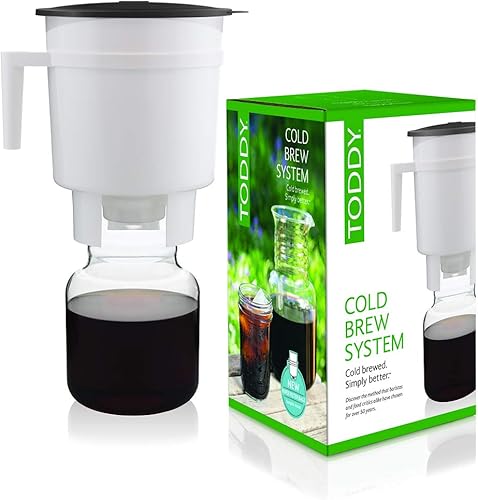 Toddy Cold Brew System
Serious cold brew households and hosts who want a large batch of true concentrate, plus tea brewing from the same system.
Best large immersion batch
 Mueller RapidBrew Cold Brew Coffee Maker 64 oz
Daily-drinking households that want the biggest simple immersion batch at a mid-range outlay.
Best large fridge pitcher
 Takeya Deluxe Cold Brew Coffee Maker 2 Quart Stone
Daily cold brew drinkers who want a simple immersion brewer that lives in the fridge and pours straight from it.
The Toddy system is the large-batch pick for concentrate drinkers, and the Mueller RapidBrew 64 oz is the large-batch pick for simple immersion. The Takeya 2 Quart is the large-batch fridge pitcher, and the OXO 32 oz wins where a smaller vessel still yields many drinks through dilution.
The picks, ranked
| Pick | Capacity | Includes | Filters | Buy |
|---|---|---|---|---|
| Best large concentrate batchToddy Cold Brew System | 1.8 litres | Brewing container with lid and handle, glass decanter with lid | 2 reusable felt filters, 1 silicone stopper | Check price |
| Best large immersion batchMueller RapidBrew Cold Brew Coffee Maker 64 oz | 64 oz | - | - | Check price |
| Best large fridge pitcherTakeya Deluxe Cold Brew Coffee Maker 2 Quart Stone | 2 quarts | - | - | Check price |
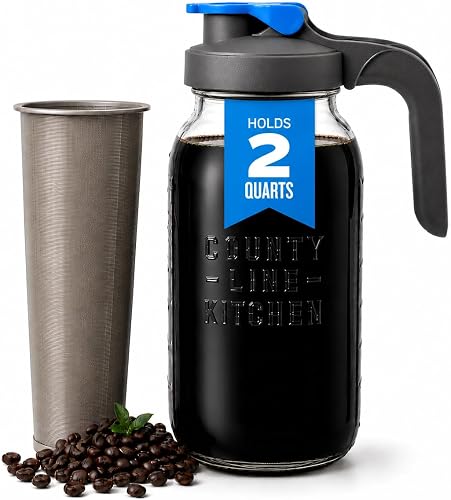 Best large glass batchCounty Line Kitchen Glass Cold Brew Coffee Maker 2 Quart Gray | 2 quarts, 64 oz | - | - | Check price |
 Best large concentrate brewerOXO Brew Cold Brew Coffee Maker 32 oz | 32 oz brewer | - | - | Check price |
Best large concentrate batch
Toddy Cold Brew System
The original concentrate system: a brewing container, felt filters, and a glass decanter, trusted by cafes as the standard for cold brew.
Strengths
- The felt filter system produces a remarkably clean, low-sediment concentrate, which is why cafes adopted it as a standard.
- A large batch suits households and gatherings: brew once, dilute for many drinks over days.
- The same system brews tea leaves as well as coffee, so it earns its counter space twice over.
Limitations
- Felt filters need care and eventual replacement, unlike a stainless mesh filter that rinses and lasts indefinitely.
- Draining takes time and attention: the stopper, decanter, and filter all need handling in the right order.
- The two-piece system takes more counter and fridge space than a single pitcher brewer.
What owners report
Commonly praised
- The felt-filtered concentrate tastes noticeably cleaner and smoother than mesh-only batches
- One large batch supplies a household for days and still tastes fresh
- Brewing tea in the same system earns the counter space twice over
Common complaints
- Felt filters need drying and replacing, unlike a mesh filter that simply rinses
- The draining routine takes attention and a few minutes to get right
- The two-piece system occupies more space than a single pitcher brewer
Recurring themes from owner reviews on retailers and forums, summarised by our editors. Updated October 2026.
| Capacity | 1.8 litres |
|---|---|
| Includes | Brewing container with lid and handle, glass decanter with lid |
| Filters | 2 reusable felt filters, 1 silicone stopper |
| Steep | Up to 12 hours, per maker guidance |
| Also brews | Tea leaves |
Best for: Serious cold brew households and hosts who want a large batch of true concentrate, plus tea brewing from the same system.
Skip if: You brew only for yourself, you dislike felt filters, or you want a single pitcher that pours straight from the fridge.
Best large immersion batch
Mueller RapidBrew Cold Brew Coffee Maker 64 oz
The large-batch value pick: a 64 oz brewer for households that drink cold brew daily and want a full fridge pitcher from one steep.
Strengths
- A 64 oz batch covers several days for a household, so brewing becomes a weekly routine rather than a daily chore.
- The fine-mesh filter keeps grounds contained for a clean pour without paper filters to buy.
- A simple immersion design has few parts to clean and nothing mechanical to fail.
Limitations
- A full 64 oz brewer is tall and heavy, so it needs a strong fridge shelf and careful handling.
- The last glasses of a long-stored batch lose brightness, so large does not always mean better if drinking is slow.
- Like all immersion brewers, the wet filter drips on removal and needs a sink nearby.
What owners report
Commonly praised
- A single 64 oz steep covers a household for days without daily brewing
- The simple design has no mechanism to break or learn
- The fine mesh gives a clean pour with no paper filters to buy
Common complaints
- A full large brewer is tall and heavy on a fridge shelf
- Slow drinkers find the last glasses lose brightness before the batch ends
- The wet filter drips on removal and really needs a sink nearby
Recurring themes from owner reviews on retailers and forums, summarised by our editors. Updated October 2026.
| Capacity | 64 oz |
|---|---|
| Filter | Fine-mesh filter |
| Design | Immersion brewer |
| Use | Cold brew concentrate and ready-to-drink batches |
| Household | Multi-drinker batches |
Best for: Daily-drinking households that want the biggest simple immersion batch at a mid-range outlay.
Skip if: Your fridge is small, you drink alone, or you want a switch-release concentrate system.
Best large fridge pitcher
Takeya Deluxe Cold Brew Coffee Maker 2 Quart Stone
The fridge pitcher done right: a shatterproof Tritan jug, a fine-mesh filter, and an airtight lid that keeps concentrate fresh for days.
Strengths
- The airtight, leakproof lid seals the pitcher for fridge storage, so concentrate stays fresh and the pitcher can lie on its side without worry.
- The fine-mesh filter holds coarse grounds well, giving a clean pour without a second strain through paper in most cases.
- Tritan plastic is shatterproof and lighter than glass, which matters for a two-quart pitcher handled daily when full.
Limitations
- Immersion brewing means lifting a wet filter out of the pitcher, which drips unless you work over a sink.
- The filter takes up space inside the pitcher, so the finished yield is less than the pitcher's full volume.
- Very fine grounds can slip through mesh, so grind size matters more than with a paper-filter system.
What owners report
Commonly praised
- The airtight lid keeps fridge coffee tasting like coffee instead of last night's leftovers
- The shatterproof jug survives daily handling that would worry a glass owner
- Pouring straight from the fridge makes the morning routine effortless
Common complaints
- Lifting the wet filter out drips unless done carefully over a sink
- Fine grounds sometimes slip through the mesh when the grind is too fine
- The filter inside eats into the finished volume of each batch
Recurring themes from owner reviews on retailers and forums, summarised by our editors. Updated October 2026.
| Capacity | 2 quarts |
|---|---|
| Material | BPA-free Tritan pitcher |
| Lid | Airtight, leakproof |
| Filter | Fine-mesh filter |
| Handle | Silicone grip handle |
Best for: Daily cold brew drinkers who want a simple immersion brewer that lives in the fridge and pours straight from it.
Skip if: You want a switch-release concentrate system, or you dislike lifting a filter out of a full pitcher.
Best large glass batch
County Line Kitchen Glass Cold Brew Coffee Maker 2 Quart Gray
The mason-jar brewer: a wide-mouth glass jar with a leakproof lid, equally happy making cold brew, iced tea, or infused water.
Strengths
- The wide mouth makes filling, emptying, and cleaning easy, with no narrow neck to trap grounds.
- A leakproof lid and sturdy glass jar suit fridge storage and table serving alike, without a separate decanter.
- One jar covers cold brew, iced tea, and infused water, so it earns space in kitchens that dislike single-use gadgets.
Limitations
- Glass at two quarts is heavy when full, and a drop on a hard floor ends the brewer.
- There is no release mechanism: the filter lifts out by hand and drips unless handled over a sink.
- The jar shape is wide, so it needs a fridge shelf with width as well as height.
What owners report
Commonly praised
- The wide mouth makes filling and scrubbing out grounds genuinely easy
- One jar handles cold brew, iced tea, and infused water through the summer
- The leakproof lid gives confidence for fridge storage and table serving
Common complaints
- Two quarts of glass are heavy when full and unforgiving if dropped
- The filter lifts out by hand with the usual drips
- The wide jar needs shelf width as well as height in the fridge
Recurring themes from owner reviews on retailers and forums, summarised by our editors. Updated October 2026.
| Capacity | 2 quarts, 64 oz |
|---|---|
| Material | Heavy-duty glass jar |
| Mouth | Wide mouth |
| Lid | Leakproof |
| Also makes | Iced tea and infused water |
Best for: Kitchens that like multi-use jars, wide-mouth cleaning, and a brewer that doubles as a sun-tea and infused-water pitcher.
Skip if: You want a release switch, a concentrate system, or a shatterproof pitcher for daily family use.
Best large concentrate brewer
OXO Brew Cold Brew Coffee Maker 32 oz
The steep-and-release benchmark: a Rainmaker top for even saturation, a long steep, and a switch that drains concentrate into the carafe below.
Strengths
- The Rainmaker top distributes water evenly over coarse grounds, so the whole bed steeps rather than channelling down one side.
- The brew-release switch separates grounds from concentrate without lifting, pouring, or second straining, which is where most cold brew mess happens.
- A long steep produces a genuine concentrate, giving up to a dozen or more drinks from one batch, diluted to taste with water, milk, or ice.
Limitations
- The brewer is tall when assembled, so it needs fridge or counter clearance that a simple pitcher does not.
- Concentrate brewing means a long wait: this is a plan-ahead brewer, not a morning-of solution.
- The filter and release mechanism need rinsing after every batch, or stale grounds flavour the next one.
What owners report
Commonly praised
- The release switch drains concentrate without the usual dripping-filter mess over the sink
- The Rainmaker top soaks the grounds evenly, so batches taste balanced rather than patchy
- One steep supplies diluted drinks for days without brewing again
Common complaints
- The assembled brewer is tall and needs a fridge shelf with real clearance
- Waiting most of a day for a batch frustrates owners who decide late
- The filter and release parts need a rinse after every single batch
Recurring themes from owner reviews on retailers and forums, summarised by our editors. Updated October 2026.
| Capacity | 32 oz brewer |
|---|---|
| Steep | 12 to 24 hours |
| Saturation | Rainmaker perforated top |
| Release | Brew-release switch into carafe |
| Yield | Concentrate for up to 14 drinks, per maker |
Best for: Coffee lovers who want a proper concentrate system with the least mess, and who brew regularly enough to justify a dedicated brewer.
Skip if: Your fridge shelf is short, you brew only a single glass at a time, or you dislike paper or mesh filter routines.
Questions, answered
How much coffee do I need for a large batch?
Follow the maker's ratio rather than guessing: concentrate systems use far more grounds per batch than ready-to-drink pitchers, because the result is diluted afterwards. Weighing grounds, even roughly, beats scooping by eye for large batches, where a ratio error wastes a lot of coffee.
Does large-batch cold brew go stale before it is finished?
Concentrate holds up better than ready-to-drink coffee, especially sealed and refrigerated, but even concentrate fades after a week or so. If a household cannot finish a batch in that window, a smaller brewer brewed more often tastes better than a large batch nursed too long.
Can I scale a small-batch recipe up directly?
Mostly, since cold brew scales linearly with ratio and steep time, but a very large vessel steeps slightly differently as grounds settle. Taste the first large batch a little early, and adjust the next one rather than assuming the small-batch timing transfers exactly.