Best of
The Best Portable Power Stations (2026)
The best portable power stations of 2026: EcoFlow DELTA 2, Jackery Explorer 1000 v2, BLUETTI AC180, Anker SOLIX C1000 Gen 2, and more, compared on capacity, output, and weight.
Our top picks at a glance
Best overall
 EcoFlow DELTA 2
Households and campers who want one station that covers a fridge, a router, laptops, and lights without stepping up to a heavy flagship.
Best for longer outages
 Jackery Explorer 1000 v2
Campers, van owners, and households who want strong AC output in a station that is still genuinely portable.
Best for home essentials
 BLUETTI AC180
Households that want a fridge, a router, and lights kept running through an outage, with fast recharge when power returns.
For most buyers, the EcoFlow DELTA 2 is the pick: 1,024Wh and 1,800W cover a fridge, a router, and laptops, with expansion if needs grow. Campers who carry their station should buy the EcoFlow RIVER 2 Pro or the Jackery Explorer 300 Plus, households preparing for long outages should buy the EcoFlow DELTA Pro, and buyers who need a station ready again quickly should buy the Anker SOLIX C1000 Gen 2. Small-device buyers on a tight budget should start with the BLUETTI EB3A or the EcoFlow RIVER 2 and check the load list honestly before ordering.
The picks, ranked
| Pick | Capacity | AC output | Battery | Buy |
|---|---|---|---|---|
| Best overallEcoFlow DELTA 2 | 1,024Wh | 1,800W | LiFePO4 (lithium iron phosphate) | Check price |
| Best for longer outagesJackery Explorer 1000 v2 | 1,070Wh | 1,500W, 3,000W surge | LiFePO4 (lithium iron phosphate) | Check price |
| Best for home essentialsBLUETTI AC180 | 1,152Wh | 1,800W, 2,700W peak | LiFePO4 (lithium iron phosphate) | Check price |
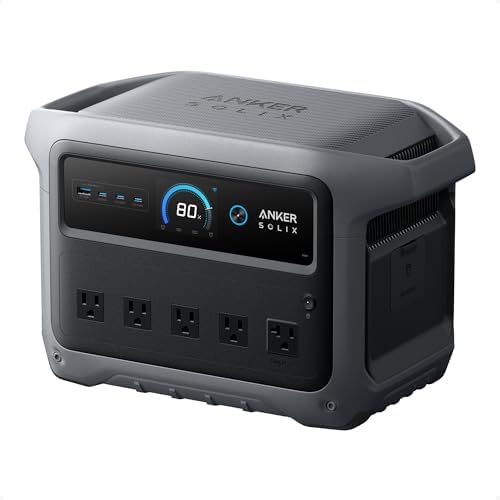 Best for fast rechargeAnker SOLIX C1000 Gen 2 | 1,024Wh | 2,000W, 3,000W peak | LiFePO4 (lithium iron phosphate) | Check price |
 Best for serious home backupEcoFlow DELTA Pro | 3,600Wh | 3,600W, higher with X-Boost | LiFePO4 (lithium iron phosphate) | Check price |
 Best mid-size camping stationEcoFlow RIVER 2 Pro | 768Wh | 800W, 1,600W with X-Boost | LiFePO4 (lithium iron phosphate) | Check price |
 Best for road tripsAnker SOLIX C800 | 768Wh | 1,200W, 1,600W surge | LiFePO4 (lithium iron phosphate) | Check price |
 Best compact backupBLUETTI EB3A | 268Wh | 600W, 1,200W surge | LiFePO4 (lithium iron phosphate) | Check price |
 Best lightweight camping stationJackery Explorer 300 Plus | 288Wh | 300W | LiFePO4 (lithium iron phosphate) | Check price |
 Best tiny station for devicesEcoFlow RIVER 2 | 256Wh | 300W, up to 600W with boost | LiFePO4 (lithium iron phosphate) | Check price |
Best overall
EcoFlow DELTA 2
The balanced mid-size station: enough capacity and output for most homes, with expansion if a longer outage arrives.
Strengths
- The 1,024Wh capacity and 1,800W AC output cover the appliances most homes actually use in an outage, from a fridge to a television, without the weight and bulk of a flagship unit.
- Expandable capacity means the station can grow with extra batteries later, so a buyer is not locked into the original capacity if backup needs change.
- Fast mains charging, reaching most of a full charge in well under two hours on the maker's figures, makes it practical to top up between uses rather than planning a day around charging.
Limitations
- At this size it is a two-handed carry and a boot item rather than a backpack item, so it suits car camping and home use more than walking trips.
- Solar charging needs a compatible panel bought separately, and full solar recharge takes far longer than mains charging, so solar should be planned as a slow top-up, not a quick refill.
- Running a fridge and several other loads together drains the battery noticeably faster than running small electronics alone, so load discipline matters in a long outage.
What owners report
Commonly praised
- Owners like that one mid-size unit covers a fridge, a router, and laptops together without needing a flagship
- Owners praise the fast mains recharge that makes the station usable again after a short break
- Owners value the option to add extra capacity later instead of replacing the whole unit
Common complaints
- Owners find the unit heavy to move once it is placed in a room
- Owners note that a fridge plus several other loads drains the battery sooner than a light load list
- Owners wish solar recharging were quicker without buying a large panel set
Recurring themes from owner reviews on retailers and forums, summarised by our editors. Updated October 2026.
| Capacity | 1,024Wh |
|---|---|
| AC output | 1,800W |
| Battery | LiFePO4 (lithium iron phosphate) |
| Charging | Mains, solar, and car charging |
| Expansion | Compatible with extra batteries for higher capacity |
Best for: Households and campers who want one station that covers a fridge, a router, laptops, and lights without stepping up to a heavy flagship.
Skip if: You need to run high-draw heating appliances for hours, or you want the lightest station possible for a hiking trip.
Best for longer outages
Jackery Explorer 1000 v2
The camper's big station: strong output, a foldable handle, and a battery built for years of regular use.
Strengths
- The 1,070Wh capacity and 1,500W AC output run a fridge, a small cooking appliance, or power tools, with a surge headroom that handles motor start-up loads.
- A foldable handle and a weight around 10.8 kg keep it manageable for one person, which is not true of every station in this capacity class.
- The lithium iron phosphate battery is rated for thousands of cycles, so regular weekend use over many years is a realistic expectation rather than a hope.
Limitations
- The one-hour fast charge needs an emergency mode switched on in the app, and the default charge is slower, so buyers who never open the app will not see the headline speed.
- Solar charging works only with Jackery panels, which limits choice if a buyer already owns panels from another brand.
- Three AC outlets are fewer than some rivals offer at this size, so a power strip may still be needed for a busy campsite or a home office.
What owners report
Commonly praised
- Owners like the strong output that handles a fridge and small cooking gear at a base camp
- Owners praise the foldable handle that makes a large station easier to carry by one person
- Owners value the long-life battery that suits regular weekend use over many years
Common complaints
- Owners find the fastest charging mode hidden behind an app setting
- Owners note that solar charging works only with the same brand panels
- Owners wish there were more AC outlets for a busy campsite
Recurring themes from owner reviews on retailers and forums, summarised by our editors. Updated October 2026.
| Capacity | 1,070Wh |
|---|---|
| AC output | 1,500W, 3,000W surge |
| Battery | LiFePO4 (lithium iron phosphate) |
| Weight | Around 10.8 kg |
| Extras | Foldable handle, app control, LED light |
Best for: Campers, van owners, and households who want strong AC output in a station that is still genuinely portable.
Skip if: Your budget is tight, or you only need to charge phones and a laptop on short trips.
Best for home essentials
BLUETTI AC180
The home-essentials workhorse: big capacity, fast mains charging, and a UPS mode for gear that must not drop out.
Strengths
- The 1,152Wh capacity and 1,800W output handle home essentials comfortably, and the power-lifting mode stretches output further for heavier resistive loads.
- Mains charging to most of a full charge in under an hour on the maker's figures means the station is ready again quickly after a short outage.
- A fast UPS switchover keeps a desktop computer or a router running through a brief mains interruption, which is a genuine practical benefit, not a gimmick.
Limitations
- It is heavy for its class, so it belongs in a fixed spot at home or in a vehicle, not in a rucksack.
- Capacity is fixed, with no extra-battery expansion, so buyers who later want much longer runtime must buy a second unit or a larger station.
- The fan can be heard under heavy load, which matters if the station sits beside a bed during a night-time outage.
What owners report
Commonly praised
- Owners like the large capacity that keeps home essentials running through an outage
- Owners praise the quick mains recharge that gets the station ready again soon after power returns
- Owners value the UPS behaviour that keeps a router and a computer running through brief interruptions
Common complaints
- Owners find the unit heavy and awkward to carry any distance
- Owners note fan noise becomes noticeable under heavy load at night
- Owners wish capacity could be expanded with an extra battery
Recurring themes from owner reviews on retailers and forums, summarised by our editors. Updated October 2026.
| Capacity | 1,152Wh |
|---|---|
| AC output | 1,800W, 2,700W peak |
| Battery | LiFePO4 (lithium iron phosphate) |
| Solar input | Up to 500W solar input |
| UPS | Fast UPS switchover for connected equipment |
Best for: Households that want a fridge, a router, and lights kept running through an outage, with fast recharge when power returns.
Skip if: You need to carry the station far on foot, or you want expandable capacity for very long outages.
Best for fast recharge
Anker SOLIX C1000 Gen 2
The fast-charging all-rounder: 2,000W of output, ten ports, and a recharge that fits into a lunch break.
Strengths
- The 2,000W AC output and ten ports cover a busy load list at once, from a fridge to laptops, lights, and tools, without constant unplugging.
- Ultra-fast mains charging, with a full recharge in under an hour on the maker's figures when the fast mode is enabled in the app, is genuinely useful between trips.
- A fast UPS switchover protects sensitive equipment during brief interruptions, and the compact footprint suits a utility room or an RV locker.
Limitations
- The headline recharge speed needs the fast mode enabled in the app, so the out-of-box experience is slower than the headline suggests.
- At 1,024Wh it is not a multi-day home backup on its own, and heavy loads will still drain it in hours, so capacity expectations must stay realistic.
- App features add convenience but also add a setup step that buyers who want a simple plug-and-go station may find unnecessary.
What owners report
Commonly praised
- Owners like the high output and generous port count that reduce unplugging and swapping
- Owners praise the very fast recharge that fits around a short stop at home
- Owners value the compact footprint that fits a utility room or an RV locker
Common complaints
- Owners find the headline recharge speed needs an app mode switched on first
- Owners note that heavy loads still drain the battery in hours despite the strong output
- Owners wish the app setup were simpler for buyers who want plug-and-go use
Recurring themes from owner reviews on retailers and forums, summarised by our editors. Updated October 2026.
| Capacity | 1,024Wh |
|---|---|
| AC output | 2,000W, 3,000W peak |
| Battery | LiFePO4 (lithium iron phosphate) |
| Ports | Ten output ports |
| UPS | Fast UPS switchover |
Best for: Buyers who need a station ready again quickly, and who run several devices at once at home, in an RV, or on site.
Skip if: You want the largest possible capacity for multi-day backup, or you dislike app-dependent charging modes.
Best for serious home backup
EcoFlow DELTA Pro
The serious home backup: huge capacity, huge output, and expansion for households that plan for long outages.
Strengths
- The 3,600Wh capacity and 3,600W AC output run heavy home appliances that smaller stations cannot, and the boost mode stretches output further still.
- Expansion with extra batteries and pairing with a second unit gives a path from a portable station to a whole-home backup system without starting again.
- Five charging routes, including mains, solar, car, EV station, and a smart generator, mean the station can be refilled in situations where a single charging route would fail.
Limitations
- It is very heavy and bulky, so it is a semi-permanent home or RV unit, not a camping companion to carry by hand over any distance.
- The premium tier reflects a large investment, and buyers with modest loads will get most of the practical benefit from a mid-size station at far lower outlay.
- Full solar recharge needs a large panel array, so solar should be treated as a long, sunny-day refill rather than a quick top-up.
What owners report
Commonly praised
- Owners like the huge capacity and output that cover heavy home appliances other stations cannot
- Owners praise the expansion path that turns a portable unit into a larger home backup system
- Owners value the many charging routes that keep refilling possible in varied situations
Common complaints
- Owners find the size and weight make it a fixed home or RV unit rather than a portable one
- Owners note that full solar recharge needs a large panel array and a sunny day
- Owners wish the outlay were lower for households with only modest loads
Recurring themes from owner reviews on retailers and forums, summarised by our editors. Updated October 2026.
| Capacity | 3,600Wh |
|---|---|
| AC output | 3,600W, higher with X-Boost |
| Battery | LiFePO4 (lithium iron phosphate) |
| Expansion | Expandable with extra batteries |
| Charging | Mains, solar, car, EV station, and smart generator |
Best for: Households preparing for long outages, RV owners with heavy loads, and anyone who wants a station that can be expanded into a home battery system.
Skip if: You need to carry the station regularly, or your loads are small electronics and a fridge for a few hours only.
Best mid-size camping station
EcoFlow RIVER 2 Pro
The camping sweet spot: light enough to carry, strong enough for a fridge, and charged in about an hour.
Strengths
- The 768Wh capacity and 800W AC output, with a boost mode for higher loads, cover a campsite fridge and everyday electronics with room to spare.
- A full mains recharge in about 70 minutes on the maker's figures means a lunch stop or a morning at a hook-up can refill the station for another day.
- At around 7.8 kg it is light for its capacity, with a built-in handle that makes a campsite carry genuinely easy.
Limitations
- Capacity still limits high-draw use: a fridge plus cooking appliances together will drain it well before a weekend is over.
- Solar recharge needs a compatible panel and good sun, and takes several hours, so it cannot replace mains charging on a cloudy trip.
- It has no extra-battery expansion, so buyers who outgrow its capacity must step up to a larger station rather than adding a battery.
What owners report
Commonly praised
- Owners like the light carry weight for a station that still runs a campsite fridge
- Owners praise the fast mains recharge that refills the unit during a lunch stop
- Owners value the simple handle and compact shape that fit a car boot easily
Common complaints
- Owners find that a fridge plus cooking gear together drains the battery well before a weekend ends
- Owners note solar recharging takes several hours and needs good sun
- Owners wish an extra battery could be added later instead of stepping up to a larger unit
Recurring themes from owner reviews on retailers and forums, summarised by our editors. Updated October 2026.
| Capacity | 768Wh |
|---|---|
| AC output | 800W, 1,600W with X-Boost |
| Battery | LiFePO4 (lithium iron phosphate) |
| Weight | Around 7.8 kg |
| Charging | Mains, solar, and car charging |
Best for: Campers and van owners who want a fridge, lights, and laptops covered for a weekend without hauling a flagship station.
Skip if: You need to run heating appliances, or you want multi-day home backup without recharging.
Best for road trips
Anker SOLIX C800
The road-trip station: a tidy storage compartment, ten ports, and a recharge that keeps pace with a travel day.
Strengths
- The 768Wh capacity and 1,200W output run most travel loads, from a cool box to laptops and camera batteries, with a surge mode for demanding starts.
- A built-in storage compartment keeps small cables and accessories with the station instead of loose in a bag, which is a small detail that matters on the road.
- Fast mains charging, under an hour on the maker's figures with the fast mode on, means a stop at a hook-up or a home socket refills it quickly.
Limitations
- Solar input is capped at a modest level, so solar recharging is a slow background task rather than a fast refill.
- Capacity is fixed, so longer trips without mains access need careful load planning or a second charging route.
- The fast charge mode is app-enabled, so buyers who skip the app will see a slower, though still reasonable, recharge.
What owners report
Commonly praised
- Owners like the ten ports that let a whole family charge devices at once on a trip
- Owners praise the built-in storage that keeps cables with the station instead of loose in a bag
- Owners value the fast recharge that keeps pace with a travel day
Common complaints
- Owners find solar recharging slow because the solar input is capped at a modest level
- Owners note the fast charge mode needs the app to reach its headline speed
- Owners wish capacity could be expanded for longer trips without mains access
Recurring themes from owner reviews on retailers and forums, summarised by our editors. Updated October 2026.
| Capacity | 768Wh |
|---|---|
| AC output | 1,200W, 1,600W surge |
| Battery | LiFePO4 (lithium iron phosphate) |
| Ports | Ten output ports |
| Extras | Built-in storage compartment |
Best for: Road trippers, van owners, and families who want one station for a car boot, a campsite, and a short home outage.
Skip if: You want the largest capacity in this size class, or you need to run a large fridge for days without recharging.
Best compact backup
BLUETTI EB3A
The small station that still has mains sockets: a desk, tent, and short-outage backup in a genuinely portable box.
Strengths
- Nine outlets in a compact unit cover phones, laptops, cameras, and lights at once, which is more versatility than a power bank can offer.
- Very fast mains charging, with most of a full charge in about half an hour on the maker's figures using combined inputs, suits a quick top-up before leaving.
- A UPS mode protects a desktop computer or a router from a brief mains interruption, a useful feature at this size and tier.
Limitations
- At 268Wh it is a small-energy station: a fridge or a kettle will drain it quickly, so it must be bought for small loads, not whole-home backup.
- The solar charging cable is not included in some listings, so solar buyers must check the box contents before ordering.
- Two AC outlets limit how many mains devices can run at once without a power strip.
What owners report
Commonly praised
- Owners like the compact size that fits a desk, a tent corner, or a car footwell
- Owners praise the fast recharge that makes a small station usable again after a short break
- Owners value the UPS behaviour that protects a computer or a router during brief interruptions
Common complaints
- Owners find the small capacity runs flat quickly on a fridge or a kettle
- Owners note the solar cable is missing from some listings and must be checked
- Owners wish there were more than two AC outlets for a busy desk
Recurring themes from owner reviews on retailers and forums, summarised by our editors. Updated October 2026.
| Capacity | 268Wh |
|---|---|
| AC output | 600W, 1,200W surge |
| Battery | LiFePO4 (lithium iron phosphate) |
| Solar input | Up to 200W solar input |
| Outlets | Nine outlets in total |
Best for: Buyers who need mains power for small devices, a laptop, and lights, and who value portability above long runtime.
Skip if: You need to run a fridge, a kettle, or any heating appliance for more than a short spell.
Best lightweight camping station
Jackery Explorer 300 Plus
The lightest Jackery here: a backpack-friendly station for cameras, drones, and a laptop on the trail.
Strengths
- At around 3.75 kg it is light enough to carry in a pack, which sets it apart from almost every larger station in this guide.
- A 100W USB-C port charges a laptop properly, not just trickle-charges it, which matters for photographers and remote workers.
- App control over Wi-Fi and Bluetooth lets a user check remaining charge and adjust settings without walking back to the station.
Limitations
- The 300W AC output rules out most heating and motor loads, so it is strictly a small-electronics station.
- A separate adapter is needed to connect some solar panels, which is an extra part to remember and to buy.
- Capacity of 288Wh means even a laptop and a camera charger together will use a large share of a charge in one working day.
What owners report
Commonly praised
- Owners like the light weight that makes the station genuinely packable for walking trips
- Owners praise the strong USB-C port that charges a laptop properly rather than slowly
- Owners value the app control that shows remaining charge without walking back to the unit
Common complaints
- Owners find the modest AC output rules out most heating and motor loads
- Owners note a separate adapter is needed for some solar panels
- Owners wish capacity lasted longer when a laptop and camera chargers run together
Recurring themes from owner reviews on retailers and forums, summarised by our editors. Updated October 2026.
| Capacity | 288Wh |
|---|---|
| AC output | 300W |
| Battery | LiFePO4 (lithium iron phosphate) |
| Weight | Around 3.75 kg |
| Extras | App control, one-button start |
Best for: Hikers, photographers, and weekend campers who carry their power and need mains sockets for small gear.
Skip if: You need to run a fridge, a power tool, or a cooking appliance.
Best tiny station for devices
EcoFlow RIVER 2
The smallest serious station: a 3.5 kg box that turns a tent or a desk into a mains-powered workspace.
Strengths
- At around 3.5 kg it is the easiest station here to carry, with a built-in handle and a footprint that fits a tent corner or a car footwell.
- A one-hour mains recharge on the maker's figures means it can be refilled during a meal stop rather than overnight.
- The lithium iron phosphate battery is rated for thousands of cycles, so daily small-load use over many years is realistic.
Limitations
- At 256Wh it is a device charger with mains sockets, not a home backup, and buyers must not expect it to cover an evening of household loads.
- AC output is modest, so a kettle, a hair dryer, or a large power tool is out of reach.
- Solar recharge needs a compatible panel and good sun, and takes hours, so it is a top-up method, not a primary refill on a short trip.
What owners report
Commonly praised
- Owners like the very light carry weight that makes the station easy to move anywhere
- Owners praise the one-hour mains recharge that refills the unit during a meal stop
- Owners value the long-life battery that suits daily small-load use over many years
Common complaints
- Owners find the small capacity cannot cover a household evening of loads
- Owners note the modest AC output rules out kettles, hair dryers, and large tools
- Owners wish solar recharging were faster on a short trip with limited sun
Recurring themes from owner reviews on retailers and forums, summarised by our editors. Updated October 2026.
| Capacity | 256Wh |
|---|---|
| AC output | 300W, up to 600W with boost |
| Battery | LiFePO4 (lithium iron phosphate) |
| Weight | Around 3.5 kg |
| Charging | Mains, solar, and car charging |
Best for: Campers, students, and remote workers who need mains power for phones, a laptop, and lights, and who travel light.
Skip if: You need to run a fridge, a microwave, or any appliance with a motor or a heater for long.
How we chose
Capacity before output, output before extras
Capacity decides how long a station runs, output decides what it can run at all, and extras decide convenience. A station with huge output but tiny capacity drains in minutes on a heavy load, while a station with huge capacity but weak output cannot start a fridge. We ranked capacity and output together, then credited charging speed, battery chemistry, and port layout.
Real loads, not headline loads
We judged each station against loads buyers actually plug in: a fridge, a router, laptops, lights, cameras, and small cooking gear. Heating appliances and large motors were treated as a separate class, since they drain small stations fast and need a large station or a different power source entirely.
Weight and carry honesty
A station that cannot be carried to where it is needed is a home battery, not a portable station. We stated weights where the maker publishes them and penalised stations that are portable only in the sense that they have a handle.
Total system cost
Solar panels, extra batteries, and adapters are often sold separately. We noted where a headline feature needs an extra purchase, so a cheaper station does not look cheaper than it really is once the full kit is counted.
Questions, answered
What size portable power station do I need?
Add up the wattage of the devices you will run at once, then multiply by the hours you need them to run, to get a rough watt-hour figure. Phones and laptops need a small station under 300Wh. A fridge plus lights and a router for an evening needs a mid-size station around 1,000Wh. Whole-home backup for a day needs a large station above 3,000Wh, or a station with extra batteries.
Can a portable power station run a fridge?
Yes, if the station has enough output to start the fridge compressor and enough capacity to keep it running. Mid-size stations around 1,000Wh can run an efficient fridge for hours, but a fridge plus cooking appliances together will drain a mid-size station quickly. Check both the running wattage and the start-up surge of your fridge before buying.
How long does a portable power station take to recharge?
From the mains, most stations here recharge in one to two hours, with the fastest modes needing an app setting enabled. From solar, recharge takes far longer and depends on panel wattage, sun, and angle, so treat solar as a slow refill over a day, not a quick top-up. Car charging is the slowest route and suits a trickle top-up on a drive.