In-depth review
BOSU Home Balance Trainer Review (2026)
In-depth review of the BOSU Home Balance Trainer: dome and platform training, standing balance, and whether it replaces a full ball.
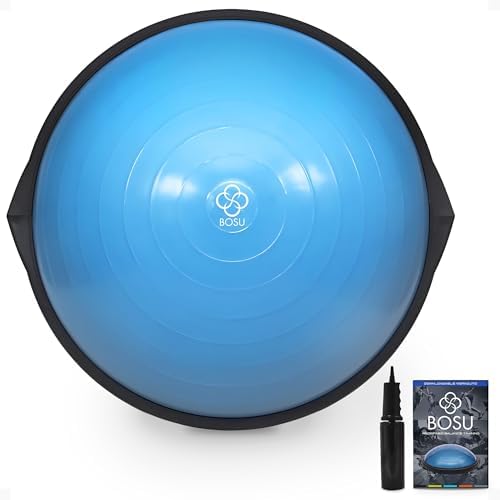
BOSU Home Balance Trainer, 26 Inch, Blue
The half-ball trainer: a dome on a flat platform for standing balance, strength, and rehab drills that a full ball cannot do.
Our verdict
The BOSU Home is the best balance trainer for standing and strength drills, because its flat platform stays put while its dome challenges balance in a way no full ball can match for standing work. It is not a replacement for a full stability ball: it cannot do seated core work, back stretches, or desk sitting. Buy it as the second balance tool in a home gym, after a full 65 cm ball, or first only if standing balance is the specific goal.
What we like
- The dome-plus-platform design works dome-up and platform-up, so one tool covers balance, strength, and rehab progressions.
- The flat base stays put on a floor, which makes standing drills far more controlled than standing on a rolling full ball.
- The trainer is made in the USA and built for repeated gym use, with a pump and workout guide included.
What to watch out for
- It is not a stability ball for sitting or lying back stretches, so it does not replace a full 65 cm ball.
- The 26 inch footprint needs dedicated floor space and storage, unlike a ball that can be tucked in a corner.
- The premium outlay is high for a single-purpose trainer, so buyers who only want core work should buy a full ball first.
Who it is for
Users focused on standing balance, single-leg drills, and platform strength work where a stable base matters.
Two tools in one shape
Dome-up work covers standing balance, squats, and single-leg holds with a soft, forgiving surface. Flip it platform-up and the flat side becomes a wobble platform for push-ups, planks, and step work. That flip is the trainer's real value: a full ball offers one unstable surface, while the BOSU offers two progressions, one soft and one hard, in a single tool.
Stability that a full ball cannot give
A full ball rolls, which is the point for seated and lying work but a problem for standing drills. The BOSU base stays where it is put, so a user can practise single-leg balance, lateral steps, and squats without chasing the equipment. For rehab progressions, that controlled instability is safer and easier to grade than a rolling ball.
How it stacks up
Against the Trideer 65 cm ball, BOSU wins on standing balance and platform strength, while Trideer wins on seated core work, back stretches, and desk sitting. Against the TheraBand Pro ball, BOSU wins on standing drills, while TheraBand wins on lying and seated rehab work. Against a mini ball, there is no real overlap: the BOSU is for standing, the mini ball is for squeezes.
What owners report
Commonly praised
- Stable platform makes standing balance drills feel controlled
- Dome-up and platform-up use give two kinds of workout in one tool
- Sturdy build holds up to repeated gym-style sessions
Common complaints
- Large footprint needs dedicated floor space and storage
- Cannot do seated core work or back stretches like a full ball
- Premium outlay is hard to justify for core-only buyers
Recurring themes from owner reviews on retailers and forums, summarised by our editors. Updated October 2026.
Key specifications
- Diameter
- 26 inches (65 cm)
- Form
- Inflatable dome on a rigid platform
- Maximum weight
- 300 lb
- Origin
- Made in the USA
- Included
- Hand pump and workout guide
Also consider

Trideer Exercise Ball for Yoga, Pilates and Fitness, 65 cm
The everyday core ball: a ribbed, slow-deflating 65 cm ball with a pump in the box and a size range that covers most adults.
- Diameter: 65 cm
- Material: PVC

TheraBand Pro Series SCP Exercise Ball, 65 cm, Green
The clinic-grade ball: a slow-deflate Pro Series build with a poster of 24 exercises, sized for taller adults.
- Diameter: 65 cm (26 inches)
- Height guide: 5 ft 7 in to 6 ft 1 in
Research-based assessment. ThePickLedger has not hands-on tested this product; this evaluation synthesizes manufacturer specifications, retailer documentation, and published expert reviews.
Questions, answered
Is the BOSU Home suitable for beginners?
Yes, with a wall or rail nearby for the first sessions. Start dome-up with both feet, short holds, and a soft surface underneath, then progress to single-leg work and platform-up drills only when two-foot balance feels steady.
How do I inflate a BOSU trainer?
Use the included pump and inflate until the dome feels firm but slightly giveable underfoot, not drum-tight. Over-inflation makes the dome hard and slippery, while under-inflation makes it sag and wobble unevenly.
Does the BOSU replace a stability ball?
No. It covers standing balance and platform strength, but it cannot do seated core work, back extensions over a ball, or desk sitting. Most home gyms benefit from both, bought in that order: full ball first, BOSU second.