In-depth review
Kalita Wave 185 Review (2026)
In-depth review of the Kalita Wave 185 Stainless: flat-bottom brewing, three drain holes, and why cafes trust it.
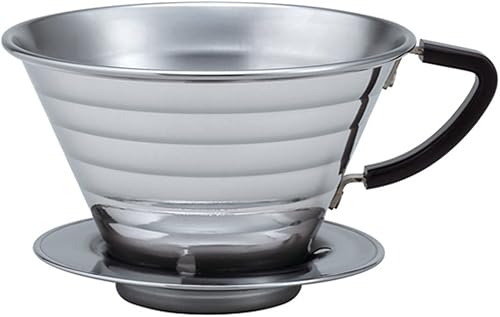
Kalita Wave 185 Stainless Steel Dripper
The forgiving flat-bottom: three small holes and a wavy filter that make an even extraction almost automatic.
Our verdict
The Kalita Wave 185 Stainless is the dripper for brewers who want great coffee without a learning curve. Its flat bed and three small holes even out the extraction by design, so a wobbly pour still produces a sweet, balanced cup, and the steel body will outlast every other brewer in the kitchen. The proprietary filters cost more than standard cones, but they are the only real caveat, and they are worth it for the forgiveness they buy.
What we like
- The flat bed and three small drain holes slow and even out the drawdown, so an imperfect pour still extracts evenly, which is why cafes trust it for busy service.
- Stainless steel is effectively indestructible in normal kitchen use, shrugs off drops that would kill ceramic, and travels well in a bag.
- The wave filter holds the bed away from the dripper wall, keeping water in contact with coffee rather than channelling down the sides.
What to watch out for
- It needs Kalita Wave 185 filters, which are pricier than standard cones and less widely stocked, so running out mid-week is a real annoyance.
- Steel holds less heat than ceramic, so the dripper needs a hot rinse first or the first seconds of the brew run cool.
- The flat-bottom cup is rounder and sweeter rather than bright and sparkling, which suits chocolatey and nutty coffees more than floral ones.
Who it is for
Brewers who want specialty-coffee quality without mastering a perfect pour, and who value durability over ceremony.
Why flat bottoms forgive
In a cone, water runs to a single point, so an uneven pour channels down one side and under-extracts the rest. In the Wave, the bed is flat, the water spreads across the whole surface, and three small holes drain it slowly and evenly. The practical result is a cup that tastes consistent from Monday to Sunday, brewed by different hands, with different kettles, at different levels of attention. That consistency is why the Wave appears on cafe brew bars, where a barista cannot give every cup a perfect spiral.
Steel that shrugs off kitchens
Ceramic drippers chip, glass drippers break, and plastic drippers stain. The steel Wave does none of these: it survives drops, travels in a bag, rinses clean in seconds, and looks the same after years of daily use. The trade is heat retention, since steel cools faster than ceramic, so a quick rinse with hot water before brewing is good practice. It is a small ritual in exchange for a dripper that never needs replacing.
How it stacks up
Against the Hario V60 Ceramic 02, the Wave wins on forgiveness and durability, while the V60 wins on brightness, control, and price. Against the Chemex Classic 6-Cup, the Wave wins on ease and toughness, while the Chemex wins on serving elegance and cup clarity. Against the Kalita Wave 185 Glass, the steel wins on durability and travel, while the glass wins on price and on watching the drawdown.
What owners report
Commonly praised
- Even a rushed and uneven pour still produces a balanced and sweet cup, which forgives busy mornings
- The steel body feels indestructible and survives drops that would destroy ceramic or glass brewers
- Years of daily use leave it looking almost new, with no staining or wear to show for it
Common complaints
- The wave filters are expensive compared with standard cones and cannot be picked up in most supermarkets
- A cold steel dripper cools the first seconds of the brew unless it is rinsed hot beforehand
- The rounder cup suits chocolatey coffees better than bright and floral ones, which some drinkers miss
Recurring themes from owner reviews on retailers and forums, summarised by our editors. Updated October 2026.
Key specifications
- Capacity
- Brews about 16 to 26 ounces, 3 to 4 servings
- Material
- Stainless steel
- Filter
- Kalita Wave 185 paper filters, not included
- Brewer shape
- Flat-bottom dripper with three drain holes
- Fit
- Sits on a mug, server, or carafe
Also consider

Kalita Wave 185 Glass Dripper
The Wave brew at a gentler price: heatproof glass, the same flat bed, and a clear view of the drawdown.
- Capacity: Brews about 16 to 26 ounces, 3 to 4 servings
- Material: Heat-resistant glass with black base

Hario V60 Ceramic Coffee Dripper, Size 02
The dripper that taught a generation to pour: a ceramic cone, a big single hole, and total control over the brew.
- Capacity: 1 to 4 cups, size 02
- Material: Ceramic
Research-based assessment. ThePickLedger has not hands-on tested this product; this evaluation synthesizes manufacturer specifications, retailer documentation, and published expert reviews.
Questions, answered
Are Kalita Wave filters really necessary?
Yes, for the intended brew. The wavy filter holds the bed away from the wall and shapes the extraction, and standard flat filters do not replicate it. Wave 185 filters are sold by coffee retailers and online, so stock up with the dripper rather than hunting for them later.
What grind size suits the Wave 185?
Medium, slightly coarser than a V60 grind, since the flat bed and small holes already slow the drawdown. If the brew stalls and tastes bitter, grind coarser; if it rushes and tastes thin, grind finer, changing one step at a time.
Does the steel Wave work on any mug?
Yes, as long as the mug rim is wide enough for the base to sit stably. Very narrow mugs can wobble, so a sturdy, wide-rimmed mug or a small server is the safest pairing, especially when the dripper is full of hot water.