Best of
The Best Knife Sharpeners (2026)
The best knife sharpeners of 2026: Chef'sChoice 15XV, Chef'sChoice 1520, Work Sharp Ken Onion Mk.2, Lansky Deluxe, and more, compared on angle, abrasive, and ease.
Our top picks at a glance
Best overall
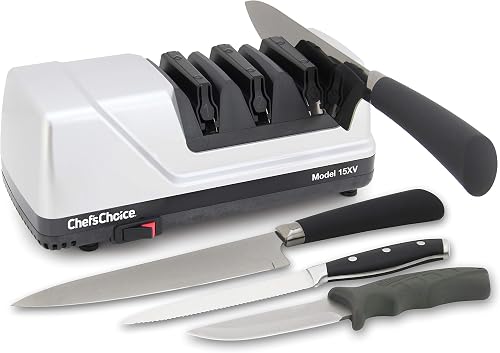 Chef'sChoice 15XV EdgeSelect Professional Electric Knife Sharpener
Home cooks who want the fastest, most foolproof route to a genuinely sharp kitchen knife, including Japanese style blades.
Best for mixed 15 and 20 degree knives
 Chef'sChoice 1520 AngleSelect Electric Knife Sharpener
Households with a mixed knife drawer: German style knives at 20 degrees alongside Japanese style knives at 15 degrees.
Best belt sharpener for versatility
 Work Sharp Ken Onion Edition Mk.2 Knife and Tool Sharpener
Owners who sharpen more than kitchen knives: pocket knives, scissors, serrated blades, and garden and workshop tools.
For most kitchens, the Chef'sChoice 15XV is the pick: a dedicated 15 degree edge, diamond abrasives, and three stages that need no skill from the user. If your drawer mixes German and Japanese knives, buy the Chef'sChoice 1520 instead, since it offers both angles. Owners who enjoy sharpening should choose the Work Sharp Precision Adjust or the Lansky Deluxe 5-Stone, and anyone who just wants a cheap drawer tool should buy the KitchenIQ Edge Grip.
The picks, ranked
Best overall
Chef'sChoice 15XV EdgeSelect Professional Electric Knife Sharpener
The kitchen electric to beat: a dedicated 15 degree edge, diamond abrasives, and three stages that take a knife from dull to polished without guesswork.
Strengths
- The dedicated 15 degree edge suits precision slicing and converts traditional 20 degree factory edges, so one machine covers both European and Japanese style kitchen knives.
- Three stages separate the work sensibly: reshaping, honing, and stropping to a polished finish, rather than asking one slot to do everything.
- Diamond abrasives cut faster than ceramic alone, so a truly dull knife comes back in a few passes instead of a long, tiring session.
Limitations
- It is built for kitchen knives first, so very thick outdoor blades and tools are better served by a belt sharpener like the Work Sharp Ken Onion.
- The machine needs counter space and a power socket, and it is not something you tuck into a drawer after use.
- An electric machine removes steel quickly, so a light touch matters: pressing hard or over-sharpening shortens a blade's life for no benefit.
What owners report
Commonly praised
- Knives come back keen after just a few slow passes through the three stages
- The fixed angle removes all guesswork for owners who never learned freehand sharpening
- Even older kitchen knives feel useful again instead of heading for replacement
Common complaints
- The machine takes up real counter space and needs a socket nearby
- A heavy hand can take off more steel than a careful owner would like
- It is overkill for anyone who only sharpens one or two basic knives
Recurring themes from owner reviews on retailers and forums, summarised by our editors. Updated October 2026.
| Stages | 3 stages |
|---|---|
| Edge angle | 15 degrees |
| Abrasive | 100% diamond abrasives with stropping disks |
| Knives | Straight edge and serrated kitchen knives |
| Size | About 10 inches long, 4.25 inches wide |
Best for: Home cooks who want the fastest, most foolproof route to a genuinely sharp kitchen knife, including Japanese style blades.
Skip if: You want to control the angle yourself, you sharpen mainly pocket or outdoor knives, or you dislike countertop appliances.
Best for mixed 15 and 20 degree knives
Chef'sChoice 1520 AngleSelect Electric Knife Sharpener
The mixed-drawer electric: choose a 15 degree edge or a traditional 20 degree edge, with diamond abrasives and precision angle guides in both slots.
Strengths
- AngleSelect gives you both common kitchen angles in one machine, so no knife in the drawer has to be sharpened at the wrong angle.
- Precision angle guides hold the blade steady through each pass, which is the part beginners usually get wrong with a freehand tool.
- The final stropping stage polishes the edge, so knives leave the machine smoother and keener than a single-stage electric can manage.
Limitations
- It is still a countertop electric, so it needs a socket and a permanent-ish home near where you prep.
- The two-angle flexibility adds a decision at every use: picking the wrong slot for a knife gives a workable but not ideal edge.
- Like any electric, it removes more steel than a whetstone session, so it is a maintenance tool, not a daily habit.
What owners report
Commonly praised
- Having both kitchen angles in one box ends the worry about sharpening a knife at the wrong angle
- The polished finish leaves edges feeling smooth rather than rough or toothy
- Santoku and everyday European knives can finally share one sharpener
Common complaints
- Choosing the right slot each time trips up owners who have never checked a knife angle
- The unit is another appliance to find a home for in a small kitchen
- Daily sharpening is unnecessary, yet the machine tempts owners to overuse it
Recurring themes from owner reviews on retailers and forums, summarised by our editors. Updated October 2026.
| Angle selection | 15 degrees or 20 degrees |
|---|---|
| Abrasive | 100% diamond abrasives |
| Edge | Two-facet arch-shaped edge |
| Knives | Straight edge and serrated knives, including Santoku |
| Guides | Precision angle guides |
Best for: Households with a mixed knife drawer: German style knives at 20 degrees alongside Japanese style knives at 15 degrees.
Skip if: Every knife you own is 15 degrees, in which case the 15XV is the more focused machine, or you want a manual tool.
Best belt sharpener for versatility
Work Sharp Ken Onion Edition Mk.2 Knife and Tool Sharpener
The do-everything belt machine: flexible abrasive belts, adjustable guides, and speed control for kitchen knives, scissors, and workshop tools alike.
Strengths
- Flexible abrasive belts follow the blade and produce a keen, consistent edge quickly, even on knives that a slot sharpener struggles with.
- Adjustable sharpening guides cover bevels from 15 to 30 degrees, so one machine suits delicate kitchen edges and sturdier tool edges.
- Variable speed with an LED display lets you grind slowly for honing and faster for reshaping, instead of one speed for every job.
Limitations
- A belt machine removes steel fast, so a heavy hand or a long pass can round a tip or overheat a thin edge.
- Belts are consumables, so long-term cost includes replacements, unlike a stone or diamond wheel system.
- It is a workshop-flavoured machine in size and noise, less at home on a small kitchen counter than a compact Chef'sChoice.
What owners report
Commonly praised
- One machine handles kitchen knives, scissors, and garden tools without buying separate gadgets
- Belt changes are quick, and the speed control makes delicate work feel controlled
- Blades that other sharpeners struggled with come back sharp in short order
Common complaints
- Belts wear out and need replacing, which adds an ongoing cost
- The machine is louder and bulkier than a quiet kitchen slot sharpener
- Beginners can round a tip if they rush a pass at high speed
Recurring themes from owner reviews on retailers and forums, summarised by our editors. Updated October 2026.
| Sharpening method | Flexible abrasive belts |
|---|---|
| Angle guides | Adjustable, 15 to 30 degrees |
| Speed control | 7 speeds with LED display |
| Sharpens | Kitchen knives, pocket knives, scissors, serrated blades, and tools |
| Includes | Replacement belts |
Best for: Owners who sharpen more than kitchen knives: pocket knives, scissors, serrated blades, and garden and workshop tools.
Skip if: You only sharpen kitchen knives and want the simplest possible machine, or belts and speed settings sound like more machine than you need.
Best guided precision system
Work Sharp Precision Adjust Knife Sharpener Kit
The guided system for people who want to learn sharpening properly: a clamped blade, a fixed angle, and stones that progress from coarse to fine.

Strengths
- The clamp holds the blade and the rod holds the angle, so every stroke lands on the same bevel instead of wandering as a hand tires.
- An adjustable angle from 15 to 30 degrees covers delicate Japanese edges and tougher outdoor edges in one kit.
- The included Tri-Brasive stones, diamond, and fine ceramic give a full progression from repair to polish without buying extras first.
Limitations
- Setup takes longer than any pull-through or electric: clamping, setting the angle, and working through grits is a deliberate session.
- Very long blades need repositioning in the clamp, which breaks the rhythm and can leave an uneven bevel if rushed.
- It is a benchtop system, not a drawer tool, so it suits owners who will sit down to sharpen rather than grab and go.
What owners report
Commonly praised
- The clamped blade and fixed rod give the same bevel on every stroke, which freehand never managed
- The wide angle range covers delicate and sturdy blades in a single kit
- Working through the stones feels satisfying rather than like a chore
Common complaints
- Setting up the clamp and rod takes longer than grabbing a pull-through
- Very long blades need repositioning, which breaks the rhythm of a session
- The kit stays on a bench, so it is not a grab-and-go drawer tool
Recurring themes from owner reviews on retailers and forums, summarised by our editors. Updated October 2026.
| System | Clamp with angle-adjustable sharpening rod |
|---|---|
| Angle range | 15 to 30 degrees |
| Abrasives | Tri-Brasive stones (320 and 600 grit), diamond, fine ceramic |
| Base | Benchtop sharpening base |
| Knives | Pocket and kitchen knives |
Best for: Knife owners who enjoy the process and want repeatable, exact angles, especially on pocket and kitchen knives they care about.
Skip if: You want a two minute electric job, you dislike setting up a clamp and rod, or you mainly sharpen very long chef's knives.
Best guided stone system
Lansky Deluxe 5-Stone Sharpening System
The classic controlled-angle kit: five stones from extra coarse to ultra fine, a clamp, and guide rods that keep beginners honest.

Strengths
- Five grits, from extra coarse 70 to ultra fine 1000, cover the whole job: reprofiling a damaged edge, sharpening, and finishing.
- Four selectable angles (17, 20, 25, and 30 degrees) let you match the edge to the knife's job instead of forcing one angle on everything.
- The clamp and guide-rod design keeps the stone at a fixed angle, which is exactly what freehand beginners struggle to do.
Limitations
- Working through five stones is slow, and skipping grits to save time leaves scratches that the finer stones then have to remove.
- The clamp suits medium blades best: very small or very long knives are awkward to hold evenly.
- Honing oil and stone care add a small routine that electric and pull-through owners never think about.
What owners report
Commonly praised
- The five-stone progression teaches real sharpening skill step by step
- The clamp keeps the angle honest even for owners with shaky hands
- The cased kit packs away neatly once a session is done
Common complaints
- Working through all five stones makes for a long session
- Honing oil and stone care add a small routine some owners skip
- Small pen knives are fiddly to hold evenly in the clamp
Recurring themes from owner reviews on retailers and forums, summarised by our editors. Updated October 2026.
| Stones | 5 stones: extra coarse 70, coarse 120, medium 280, fine 600, ultra fine 1000 |
|---|---|
| Angles | 17, 20, 25, and 30 degrees |
| Stone material | Alumina oxide ceramic |
| Includes | Clamp, guide rods, honing oil, storage case |
| Knives | Kitchen, outdoor, and workshop knives |
Best for: Learners who want a full stone progression and a proven system that has been teaching people to sharpen for decades.
Skip if: You want speed above all, or you dislike oil, clamps, and working through five separate stones.
Best value electric
Presto EverSharp Electric Knife Sharpener 08800
The straightforward value electric: two stages, automatic guides, and a razor edge for everyday non-serrated kitchen knives.

Strengths
- Two stages keep the routine simple: one stage sharpens, the second hones, with no angle decision to make.
- Automatic blade guides hold the knife at the right angle, so results do not depend on a steady hand.
- It is compact and inexpensive for an electric, so it fits kitchens where a premium Chef'sChoice feels like overkill.
Limitations
- It is designed for most non-serrated knives, so serrated bread knives need a different tool.
- There is no angle selection, so owners of 15 degree Japanese knives should look at the 15XV or the 1520 instead.
- The finish is a good working edge rather than the polished edge a stropping stage produces.
What owners report
Commonly praised
- Two stages and nothing to decide make it the simplest electric many owners have used
- Everyday knives come back to a clean working edge in minutes
- The modest size fits kitchens where bigger machines would dominate
Common complaints
- Serrated bread knives need a different tool, which surprises some buyers
- There is no angle choice for owners with Japanese style knives
- The finished edge is good rather than mirror-polished
Recurring themes from owner reviews on retailers and forums, summarised by our editors. Updated October 2026.
| Stages | 2 stages |
|---|---|
| Knives | Most non-serrated kitchen and sport knives |
| Guides | Automatic blade guides |
| Power | 120 volts, electric |
| Design | Compact countertop electric |
Best for: Everyday cooks who want an electric sharpener at a modest outlay and sharpen standard straight-edge kitchen knives.
Skip if: You need serrated sharpening, a 15 degree Japanese edge, or a machine that also handles tools and scissors.
Best manual pull-through for mixed angles
Chef'sChoice AngleSelect Manual Sharpener 4633
The Chef'sChoice angles without the socket: diamond wheels in 15 and 20 degree slots, in a manual sharpener that lives in a drawer.

Strengths
- Separate 15 and 20 degree diamond slots mean mixed drawers get the right angle without an electric machine on the counter.
- Diamond abrasives cut more effectively than the carbide slots on cheaper pull-throughs, so fewer passes restore the edge.
- The compact footprint fits a drawer or a small kitchen, and it works anywhere, with no socket or setup.
Limitations
- A manual pull-through cannot reprofile a chipped or very dull edge the way a coarse stone or electric stage can.
- Pulling technique still matters: uneven pressure or speed gives an uneven edge, even with guides.
- There is no stropping stage, so the finish is a sharp working edge rather than a mirror-polished one.
What owners report
Commonly praised
- The diamond slots restore an edge with fewer passes than cheaper carbide pull-throughs
- Living in a drawer means it is always at hand when a knife drags
- No socket or noise makes it easy to use any time of day
Common complaints
- A truly dull or chipped knife needs more than this manual tool can offer
- Uneven pulling pressure gives an uneven edge until technique improves
- The finish stops short of the polished edge an electric stropping stage gives
Recurring themes from owner reviews on retailers and forums, summarised by our editors. Updated October 2026.
| Stages | 2 stages |
|---|---|
| Angle slots | 15 degrees and 20 degrees |
| Abrasive | Diamond wheels |
| Knives | Straight edge and serrated knives |
| Design | Compact manual pull-through |
Best for: Cooks who like the Chef'sChoice angle system but want a quiet, portable, power-free tool for quick maintenance.
Skip if: You have a truly dull or damaged knife that needs reshaping, or you want a polished, stropping-stage finish.
Best whetstone starter kit
Sharp Pebble Whetstone Knife Sharpening Stone Kit 1000/6000
The whetstone way in, without the guesswork: a 1000/6000 combination stone with switchable angle guides and a non-slip base.

Strengths
- The 1000 grit side sharpens and the 6000 grit side polishes, so one stone covers the two steps most home knives need.
- Switchable angle guides at 15, 17, 20, and 22 degrees teach the correct hand position, and they can be removed for freehand sharpening later.
- A non-slip base holds the stone steady, which is the single biggest frustration for first-time whetstone users.
Limitations
- Whetstone sharpening is a skill: the first few sessions are slow and the edge improves as your technique does.
- The stone needs soaking and a wet workspace, plus drying and storage afterwards, so it is a ritual rather than a quick job.
- A 1000 grit starting point is too fine for a chipped or very dull knife, which needs a coarser stone first.
What owners report
Commonly praised
- The clip-on angle guides make a first whetstone session far less intimidating
- The polished side leaves a smooth edge that glides through vegetables
- Learning the motion feels rewarding once the first good edge appears
Common complaints
- Soaking the stone and clearing a wet workspace takes planning
- Early sessions are slow, and the edge improves only as technique does
- A badly chipped knife needs a coarser stone before this kit can help
Recurring themes from owner reviews on retailers and forums, summarised by our editors. Updated October 2026.
| Grits | 1000/6000 combination water stone |
|---|---|
| Angle guides | 15, 17, 20, and 22 degrees, switchable and removable |
| Base | Non-slip sharpening base |
| Stone type | Corundum water stone |
| Includes | Plastic base |
Best for: Beginners curious about whetstones who want guides to learn the angle, and cooks who enjoy a slower, quieter sharpening ritual.
Skip if: You want speed, you dislike soaking stones and wet counters, or you only ever want a two minute fix.
Best budget pull-through
KitchenIQ Edge Grip 2-Stage Knife Sharpener 50009
The drawer essential: a tiny two-slot sharpener with a carbide slot for dull knives and a ceramic rod slot for quick touch-ups.

Strengths
- At just a few inches long it fits a knife drawer or utensil drawer, so it is always where the knives are.
- The coarse carbide slot tackles dull and damaged edges while the fine ceramic rod slot polishes and touches up already sharp knives.
- A stable non-slip base and soft grip handle keep it steady on the counter during use, which cheaper pull-throughs often lack.
Limitations
- Carbide slots remove steel aggressively, so frequent use on a good knife will shorten its life faster than ceramic or stone sharpening.
- The preset angle cannot be adjusted, so it will not match every knife's factory angle exactly.
- It maintains an edge rather than creating a fine one: a truly dull knife still deserves a stone or electric session.
What owners report
Commonly praised
- The tiny size means it lives in the knife drawer right where the knives are
- A quick pull through the ceramic slot revives a dragging edge before dinner prep
- The non-slip base keeps it steady where other tiny sharpeners slide about
Common complaints
- The carbide slot is harsh if used on a good knife every single day
- The preset angle does not match every knife in the drawer exactly
- It maintains edges rather than rescuing knives that have gone fully dull
Recurring themes from owner reviews on retailers and forums, summarised by our editors. Updated October 2026.
| Stages | 2 stages |
|---|---|
| Coarse slot | Carbide, for dull and damaged knives |
| Fine slot | Ceramic rod, for polishing and touch-ups |
| Size | 3.75 x 2 x 1.75 inches |
| Base | Stable non-slip base with soft grip handle |
Best for: Anyone who wants a cheap, tiny tool that keeps everyday knives usable between proper sharpening sessions.
Skip if: You own expensive Japanese knives, you want a precise angle, or you need to repair a damaged edge.
Best handheld for quick touch-ups
AccuSharp Gourmet 15 Degree Knife Sharpener
The handheld fix for finer knives: a 15 degree carbide sharpener you draw along the blade, sized for gourmet and fillet-style knives.

Strengths
- The 15 degree angle suits finer gourmet edges that a standard preset sharpener would thicken and dull in feel.
- Drawing the sharpener along a held blade suits long, flexible fillet knives better than dragging the knife through a fixed slot.
- Reversible diamond-honed tungsten carbide blades extend the tool's life: flip them when one side wears.
Limitations
- A handheld tool depends on your hand for angle and pressure, so results vary more than with a clamped or guided system.
- Carbide cuts aggressively for its size, so it is a touch-up tool, not something to use on a good knife every day.
- It will not reprofile a chipped edge or restore a knife that has been neglected for a long time.
What owners report
Commonly praised
- The handheld design suits long fillet knives better than any fixed slot
- Reversible blades mean the tool keeps working long after one side wears
- Touch-ups take seconds, with no setup or socket involved
Common complaints
- Results depend heavily on the steadiness of the owner's hand
- The aggressive carbide is not a tool to use on a prized knife daily
- A chipped edge is beyond what this little tool can repair
Recurring themes from owner reviews on retailers and forums, summarised by our editors. Updated October 2026.
| Angle | 15 degrees |
|---|---|
| Abrasive | Diamond-honed tungsten carbide, reversible blades |
| Design | Hand-held |
| Knives | Straight-edge or serrated gourmet knives |
| Use | Hones and refines edges |
Best for: Cooks who want a fast handheld touch-up for finer-edged knives, including fillet knives, without setting up a system.
Skip if: You want a guided angle for a prized chef's knife, or you need to reprofile a damaged edge from scratch.
How we chose
Angle first, everything else second
A sharpener that sharpens at the wrong angle for your knives gives you a worse edge, however expensive it is. We matched each pick to the angles it genuinely offers, and we penalised preset tools that pretend one angle suits every knife.
Abrasive honesty
Diamond cuts fastest, ceramic polishes well, carbide cuts aggressively, and stones reward patience. We recorded the abrasive each maker actually lists, and we said plainly where an aggressive abrasive costs blade life if overused.
Real ease, not claimed ease
An electric that needs a socket and counter space is not as easy as a drawer tool, however simple its slots are. We judged ease on setup, session length, and cleanup together, not on the number of stages printed on the box.
Edge quality you can keep
A sharpener earns its place by producing an edge you can maintain, not a one-off miracle. We favoured tools with a progression, a polishing stage, or a repeatable angle, over single-slot gadgets that leave a rough edge.
Questions, answered
What angle should I sharpen my kitchen knives at?
Most European style kitchen knives are made for a 20 degree edge, while many Japanese style knives are made for a 15 degree edge. Sharpening a 15 degree knife at 20 degrees still works, but it feels less keen; sharpening a 20 degree knife at 15 degrees gives a finer edge that dulls faster. If your drawer mixes both, a dual-angle tool like the Chef'sChoice 1520 avoids the compromise.
How often should I sharpen my knives?
As often as they need it, which for a home cook usually means a quick honing or touch-up every few weeks and a full sharpening a few times a year. A knife that slides off a tomato skin instead of biting into it is telling you it is time. Waiting until a knife is truly dull makes the job longer and removes more steel.
Are pull-through sharpeners bad for knives?
Aggressive carbide pull-throughs remove a lot of steel, so daily use on a good knife will shorten its life. Used lightly, for maintenance between proper sharpening sessions, a pull-through like the KitchenIQ Edge Grip is a reasonable tool. For a prized knife, a ceramic slot, a guided system, or a whetstone is kinder over years of use.