Head to head
Chef'sChoice 15XV vs 1520 (2026)
Chef'sChoice 15XV vs 1520: a dedicated 15 degree edge against dual-angle flexibility, compared honestly.
#1 in our rankings · Best overall
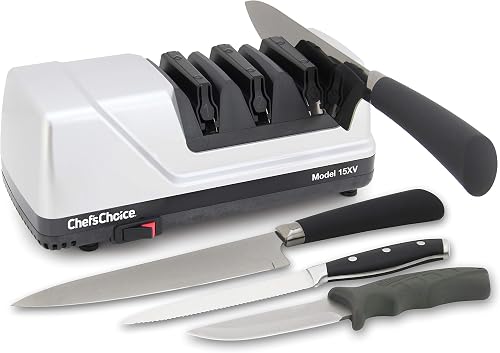
Chef'sChoice 15XV EdgeSelect Professional Electric Knife Sharpener
Best for: Home cooks who want the fastest, most foolproof route to a genuinely sharp kitchen knife, including Japanese style blades.
#2 in our rankings · Best for mixed 15 and 20 degree knives

Chef'sChoice 1520 AngleSelect Electric Knife Sharpener
Best for: Households with a mixed knife drawer: German style knives at 20 degrees alongside Japanese style knives at 15 degrees.
Our recommendation
Buy the Chef'sChoice 15XV if most of your knives are Japanese style or you want the keenest possible kitchen edge with no decisions to make. Buy the Chef'sChoice 1520 if your drawer mixes European and Japanese knives, since it gives each knife its correct angle. Both use diamond abrasives and a stropping finish; the choice is focus against flexibility.
Edge angle
The 15XV sharpens at 15 degrees only, converting 20 degree factory edges to a finer edge. The 1520 offers both 15 and 20 degree slots, so a German chef's knife keeps its factory angle while a Japanese santoku gets its finer one. Households with one knife style do not need the flexibility; mixed households do.
Simplicity against choice
The 15XV asks nothing of the user beyond drawing the knife through its three stages. The 1520 asks one question at every use: which slot does this knife belong in? That question is easy once you know your knives, but it is a real source of error for beginners who have never checked a knife's angle.
Edge character
Both machines finish with stropping, so both produce a smooth, polished edge rather than a toothy one. The 15XV's edge feels keener for precision slicing, while the 1520's 20 degree edge feels sturdier for heavy chopping, which matches the knives each angle was designed for.
Choose Chef'sChoice 15XV EdgeSelect Professional Electric Knife Sharpener if…
- Most of your knives are Japanese style or 15 degrees
- You want the keenest edge with no decisions
- You prefer one consistent geometry across the drawer
Choose Chef'sChoice 1520 AngleSelect Electric Knife Sharpener if…
- Your drawer mixes German and Japanese knives
- You want to keep 20 degree factory angles intact
- You like having both angles available in one machine
Spec-by-spec comparison
| Spec | Chef'sChoice 15XV EdgeSelect Professional Electric Knife Sharpener | Chef'sChoice 1520 AngleSelect Electric Knife Sharpener |
|---|---|---|
| Price tier | Premium | Mid-range |
| Stages | 3 stages | - |
| Edge angle | 15 degrees | - |
| Abrasive | 100% diamond abrasives with stropping disks | 100% diamond abrasives |
| Knives | Straight edge and serrated kitchen knives | Straight edge and serrated knives, including Santoku |
| Size | About 10 inches long, 4.25 inches wide | - |
| Angle selection | - | 15 degrees or 20 degrees |
| Edge | - | Two-facet arch-shaped edge |
| Guides | - | Precision angle guides |
| Best for | Home cooks who want the fastest, most foolproof route to a genuinely sharp kitchen knife, including Japanese style blades. | Households with a mixed knife drawer: German style knives at 20 degrees alongside Japanese style knives at 15 degrees. |
| Skip if | You want to control the angle yourself, you sharpen mainly pocket or outdoor knives, or you dislike countertop appliances. | Every knife you own is 15 degrees, in which case the 15XV is the more focused machine, or you want a manual tool. |
Strengths and limitations
Chef'sChoice 15XV EdgeSelect Professional Electric Knife Sharpener
Strengths
- The dedicated 15 degree edge suits precision slicing and converts traditional 20 degree factory edges, so one machine covers both European and Japanese style kitchen knives.
- Three stages separate the work sensibly: reshaping, honing, and stropping to a polished finish, rather than asking one slot to do everything.
- Diamond abrasives cut faster than ceramic alone, so a truly dull knife comes back in a few passes instead of a long, tiring session.
Limitations
- It is built for kitchen knives first, so very thick outdoor blades and tools are better served by a belt sharpener like the Work Sharp Ken Onion.
- The machine needs counter space and a power socket, and it is not something you tuck into a drawer after use.
- An electric machine removes steel quickly, so a light touch matters: pressing hard or over-sharpening shortens a blade's life for no benefit.
Chef'sChoice 1520 AngleSelect Electric Knife Sharpener
Strengths
- AngleSelect gives you both common kitchen angles in one machine, so no knife in the drawer has to be sharpened at the wrong angle.
- Precision angle guides hold the blade steady through each pass, which is the part beginners usually get wrong with a freehand tool.
- The final stropping stage polishes the edge, so knives leave the machine smoother and keener than a single-stage electric can manage.
Limitations
- It is still a countertop electric, so it needs a socket and a permanent-ish home near where you prep.
- The two-angle flexibility adds a decision at every use: picking the wrong slot for a knife gives a workable but not ideal edge.
- Like any electric, it removes more steel than a whetstone session, so it is a maintenance tool, not a daily habit.
How they fit the wider field
- Chef'sChoice 15XV EdgeSelect Professional Electric Knife Sharpener: ranked #1 (Best overall) in The Best Knife Sharpeners. Read the full Chef'sChoice 15XV EdgeSelect Professional Electric Knife Sharpener review.
- Chef'sChoice 1520 AngleSelect Electric Knife Sharpener: ranked #2 (Best for mixed 15 and 20 degree knives) in The Best Knife Sharpeners.
Neither one quite right? The full rankings cover 10 picks matched to different buyers.
Made your call?
Questions, answered
Which is better for a beginner?
The 15XV, slightly, because there is no slot decision to get wrong. The 1520 is still beginner-friendly, but only once the owner knows which knives are 15 degrees and which are 20 degrees.
Do both sharpen serrated knives?
Yes, both makers list serrated knives among the supported types. Use a light touch on serrated blades, and do not expect either machine to repair heavily damaged serrations.
Which lasts longer?
Both use diamond abrasives with a long home-use life, and neither has consumables beyond normal wear. Longevity depends more on use: heavy daily sharpening wears any machine faster than occasional maintenance.