Ranked on beginner safety: guided angles, simple stage counts, low risk of damaging a good knife, and a short learning curve.
The Best Knife Sharpeners for Beginners (2026)
Beginner knife sharpeners that hold the angle for you, forgive a heavy hand, and produce a usable edge on the first try.
Our top picks at a glance
Best beginner electric
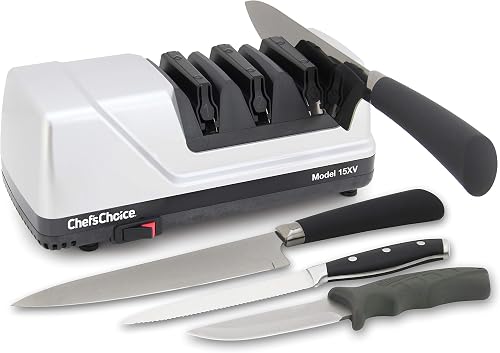 Chef'sChoice 15XV EdgeSelect Professional Electric Knife Sharpener
Home cooks who want the fastest, most foolproof route to a genuinely sharp kitchen knife, including Japanese style blades.
Best beginner value electric
 Presto EverSharp Electric Knife Sharpener 08800
Everyday cooks who want an electric sharpener at a modest outlay and sharpen standard straight-edge kitchen knives.
Best beginner drawer tool
 KitchenIQ Edge Grip 2-Stage Knife Sharpener 50009
Anyone who wants a cheap, tiny tool that keeps everyday knives usable between proper sharpening sessions.
The Chef'sChoice 15XV is the beginner pick if you want an electric: it holds the angle and does the work. If you want to spend less, the Presto EverSharp 08800 is simpler still, and the KitchenIQ Edge Grip is the no-commitment drawer tool. Beginners curious about whetstones should start with the Sharp Pebble 1000/6000, whose guides make the first sessions far less intimidating.
The picks, ranked
| Pick | Stages | Edge angle | Abrasive | Buy |
|---|---|---|---|---|
| Best beginner electricChef'sChoice 15XV EdgeSelect Professional Electric Knife Sharpener | 3 stages | 15 degrees | 100% diamond abrasives with stropping disks | Check price |
| Best beginner value electricPresto EverSharp Electric Knife Sharpener 08800 | 2 stages | - | - | Check price |
| Best beginner drawer toolKitchenIQ Edge Grip 2-Stage Knife Sharpener 50009 | 2 stages | - | - | Check price |
 Best beginner whetstoneSharp Pebble Whetstone Knife Sharpening Stone Kit 1000/6000 | - | - | - | Check price |
 Best beginner manual with anglesChef'sChoice AngleSelect Manual Sharpener 4633 | 2 stages | - | Diamond wheels | Check price |
Best beginner electric
Chef'sChoice 15XV EdgeSelect Professional Electric Knife Sharpener
The kitchen electric to beat: a dedicated 15 degree edge, diamond abrasives, and three stages that take a knife from dull to polished without guesswork.
Strengths
- The dedicated 15 degree edge suits precision slicing and converts traditional 20 degree factory edges, so one machine covers both European and Japanese style kitchen knives.
- Three stages separate the work sensibly: reshaping, honing, and stropping to a polished finish, rather than asking one slot to do everything.
- Diamond abrasives cut faster than ceramic alone, so a truly dull knife comes back in a few passes instead of a long, tiring session.
Limitations
- It is built for kitchen knives first, so very thick outdoor blades and tools are better served by a belt sharpener like the Work Sharp Ken Onion.
- The machine needs counter space and a power socket, and it is not something you tuck into a drawer after use.
- An electric machine removes steel quickly, so a light touch matters: pressing hard or over-sharpening shortens a blade's life for no benefit.
What owners report
Commonly praised
- Knives come back keen after just a few slow passes through the three stages
- The fixed angle removes all guesswork for owners who never learned freehand sharpening
- Even older kitchen knives feel useful again instead of heading for replacement
Common complaints
- The machine takes up real counter space and needs a socket nearby
- A heavy hand can take off more steel than a careful owner would like
- It is overkill for anyone who only sharpens one or two basic knives
Recurring themes from owner reviews on retailers and forums, summarised by our editors. Updated October 2026.
| Stages | 3 stages |
|---|---|
| Edge angle | 15 degrees |
| Abrasive | 100% diamond abrasives with stropping disks |
| Knives | Straight edge and serrated kitchen knives |
| Size | About 10 inches long, 4.25 inches wide |
Best for: Home cooks who want the fastest, most foolproof route to a genuinely sharp kitchen knife, including Japanese style blades.
Skip if: You want to control the angle yourself, you sharpen mainly pocket or outdoor knives, or you dislike countertop appliances.
Best beginner value electric
Presto EverSharp Electric Knife Sharpener 08800
The straightforward value electric: two stages, automatic guides, and a razor edge for everyday non-serrated kitchen knives.
Strengths
- Two stages keep the routine simple: one stage sharpens, the second hones, with no angle decision to make.
- Automatic blade guides hold the knife at the right angle, so results do not depend on a steady hand.
- It is compact and inexpensive for an electric, so it fits kitchens where a premium Chef'sChoice feels like overkill.
Limitations
- It is designed for most non-serrated knives, so serrated bread knives need a different tool.
- There is no angle selection, so owners of 15 degree Japanese knives should look at the 15XV or the 1520 instead.
- The finish is a good working edge rather than the polished edge a stropping stage produces.
What owners report
Commonly praised
- Two stages and nothing to decide make it the simplest electric many owners have used
- Everyday knives come back to a clean working edge in minutes
- The modest size fits kitchens where bigger machines would dominate
Common complaints
- Serrated bread knives need a different tool, which surprises some buyers
- There is no angle choice for owners with Japanese style knives
- The finished edge is good rather than mirror-polished
Recurring themes from owner reviews on retailers and forums, summarised by our editors. Updated October 2026.
| Stages | 2 stages |
|---|---|
| Knives | Most non-serrated kitchen and sport knives |
| Guides | Automatic blade guides |
| Power | 120 volts, electric |
| Design | Compact countertop electric |
Best for: Everyday cooks who want an electric sharpener at a modest outlay and sharpen standard straight-edge kitchen knives.
Skip if: You need serrated sharpening, a 15 degree Japanese edge, or a machine that also handles tools and scissors.
Best beginner drawer tool
KitchenIQ Edge Grip 2-Stage Knife Sharpener 50009
The drawer essential: a tiny two-slot sharpener with a carbide slot for dull knives and a ceramic rod slot for quick touch-ups.
Strengths
- At just a few inches long it fits a knife drawer or utensil drawer, so it is always where the knives are.
- The coarse carbide slot tackles dull and damaged edges while the fine ceramic rod slot polishes and touches up already sharp knives.
- A stable non-slip base and soft grip handle keep it steady on the counter during use, which cheaper pull-throughs often lack.
Limitations
- Carbide slots remove steel aggressively, so frequent use on a good knife will shorten its life faster than ceramic or stone sharpening.
- The preset angle cannot be adjusted, so it will not match every knife's factory angle exactly.
- It maintains an edge rather than creating a fine one: a truly dull knife still deserves a stone or electric session.
What owners report
Commonly praised
- The tiny size means it lives in the knife drawer right where the knives are
- A quick pull through the ceramic slot revives a dragging edge before dinner prep
- The non-slip base keeps it steady where other tiny sharpeners slide about
Common complaints
- The carbide slot is harsh if used on a good knife every single day
- The preset angle does not match every knife in the drawer exactly
- It maintains edges rather than rescuing knives that have gone fully dull
Recurring themes from owner reviews on retailers and forums, summarised by our editors. Updated October 2026.
| Stages | 2 stages |
|---|---|
| Coarse slot | Carbide, for dull and damaged knives |
| Fine slot | Ceramic rod, for polishing and touch-ups |
| Size | 3.75 x 2 x 1.75 inches |
| Base | Stable non-slip base with soft grip handle |
Best for: Anyone who wants a cheap, tiny tool that keeps everyday knives usable between proper sharpening sessions.
Skip if: You own expensive Japanese knives, you want a precise angle, or you need to repair a damaged edge.
Best beginner whetstone
Sharp Pebble Whetstone Knife Sharpening Stone Kit 1000/6000
The whetstone way in, without the guesswork: a 1000/6000 combination stone with switchable angle guides and a non-slip base.
Strengths
- The 1000 grit side sharpens and the 6000 grit side polishes, so one stone covers the two steps most home knives need.
- Switchable angle guides at 15, 17, 20, and 22 degrees teach the correct hand position, and they can be removed for freehand sharpening later.
- A non-slip base holds the stone steady, which is the single biggest frustration for first-time whetstone users.
Limitations
- Whetstone sharpening is a skill: the first few sessions are slow and the edge improves as your technique does.
- The stone needs soaking and a wet workspace, plus drying and storage afterwards, so it is a ritual rather than a quick job.
- A 1000 grit starting point is too fine for a chipped or very dull knife, which needs a coarser stone first.
What owners report
Commonly praised
- The clip-on angle guides make a first whetstone session far less intimidating
- The polished side leaves a smooth edge that glides through vegetables
- Learning the motion feels rewarding once the first good edge appears
Common complaints
- Soaking the stone and clearing a wet workspace takes planning
- Early sessions are slow, and the edge improves only as technique does
- A badly chipped knife needs a coarser stone before this kit can help
Recurring themes from owner reviews on retailers and forums, summarised by our editors. Updated October 2026.
| Grits | 1000/6000 combination water stone |
|---|---|
| Angle guides | 15, 17, 20, and 22 degrees, switchable and removable |
| Base | Non-slip sharpening base |
| Stone type | Corundum water stone |
| Includes | Plastic base |
Best for: Beginners curious about whetstones who want guides to learn the angle, and cooks who enjoy a slower, quieter sharpening ritual.
Skip if: You want speed, you dislike soaking stones and wet counters, or you only ever want a two minute fix.
Best beginner manual with angles
Chef'sChoice AngleSelect Manual Sharpener 4633
The Chef'sChoice angles without the socket: diamond wheels in 15 and 20 degree slots, in a manual sharpener that lives in a drawer.
Strengths
- Separate 15 and 20 degree diamond slots mean mixed drawers get the right angle without an electric machine on the counter.
- Diamond abrasives cut more effectively than the carbide slots on cheaper pull-throughs, so fewer passes restore the edge.
- The compact footprint fits a drawer or a small kitchen, and it works anywhere, with no socket or setup.
Limitations
- A manual pull-through cannot reprofile a chipped or very dull edge the way a coarse stone or electric stage can.
- Pulling technique still matters: uneven pressure or speed gives an uneven edge, even with guides.
- There is no stropping stage, so the finish is a sharp working edge rather than a mirror-polished one.
What owners report
Commonly praised
- The diamond slots restore an edge with fewer passes than cheaper carbide pull-throughs
- Living in a drawer means it is always at hand when a knife drags
- No socket or noise makes it easy to use any time of day
Common complaints
- A truly dull or chipped knife needs more than this manual tool can offer
- Uneven pulling pressure gives an uneven edge until technique improves
- The finish stops short of the polished edge an electric stropping stage gives
Recurring themes from owner reviews on retailers and forums, summarised by our editors. Updated October 2026.
| Stages | 2 stages |
|---|---|
| Angle slots | 15 degrees and 20 degrees |
| Abrasive | Diamond wheels |
| Knives | Straight edge and serrated knives |
| Design | Compact manual pull-through |
Best for: Cooks who like the Chef'sChoice angle system but want a quiet, portable, power-free tool for quick maintenance.
Skip if: You have a truly dull or damaged knife that needs reshaping, or you want a polished, stropping-stage finish.
Questions, answered
What is the easiest way for a beginner to sharpen a knife?
An electric sharpener with guided slots, such as the Chef'sChoice 15XV or the Presto EverSharp, because the machine holds the angle and the user only controls speed and pressure. Pull the knife through slowly and lightly, alternate sides evenly, and stop as soon as the edge bites cleanly.
How do I know when the knife is sharp enough?
Try the tomato test: a sharp knife bites into the skin with its own weight and slices without pressing down hard. If it slides or crushes, it needs more work. A paper test works too, but a tomato is the test that matches real kitchen use.
Can a beginner ruin a knife by sharpening it?
It is hard to ruin a knife with a guided electric or a fine whetstone, but an aggressive carbide pull-through used heavily can remove enough steel to change the edge profile over time. Start light, use fine abrasives, and sharpen only when the knife actually needs it.