Head to head
Audio-Technica AT-LP120XUSB vs Fluance RT81 Elite (2026)
AT-LP120XUSB vs Fluance RT81 Elite: direct drive against belt drive, DJ styling against walnut furniture, compared honestly.
#5 in our rankings · Best direct drive
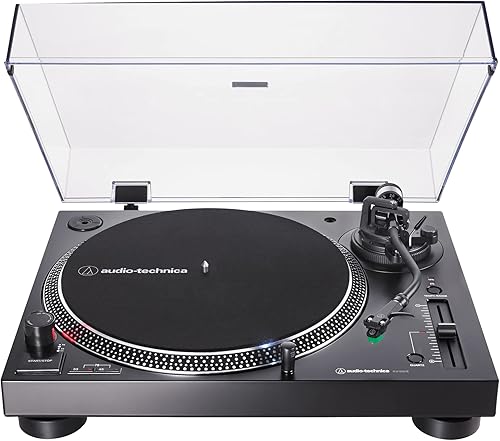
Audio-Technica AT-LP120XUSB
Best for: Listeners who want direct-drive solidity, pitch control, and the option to digitise records, without paying Technics money.
#6 in our rankings · Best value

Fluance RT81 Elite
Best for: Buyers who want a handsome, complete deck at a mid-range price, with a built-in phono stage for simple setup.
Our recommendation
Buy the Audio-Technica AT-LP120XUSB if you value direct-drive stability, pitch control, and USB archiving, and you do not mind DJ styling. Buy the Fluance RT81 Elite if you want a deck that looks like furniture, sounds warm and composed, and fits a living room without explanation. Both include a phono stage and both play well; the choice is about character, not quality.
Drive character
The Audio-Technica's quartz-locked direct drive holds pitch with authority and starts instantly, which suits long sessions and owners who notice wow. The Fluance belt drive isolates motor noise more gently and sounds slightly warmer, which suits relaxed listening. Neither is wrong, but the difference is audible on sustained piano and voice.
Looks and living room fit
The Fluance walnut plinth looks like furniture and earns compliments from non-vinyl visitors. The Audio-Technica looks like a DJ tool, with strobe markings and a chunky base that dominates a shelf. In a shared living room, the Fluance is the easier sell; in a studio or listening room, the Audio-Technica's looks are a badge of intent.
Features and archiving
The Audio-Technica adds pitch control, a strobe, 78 RPM playback, and USB output for digitising records, which the Fluance cannot match. The Fluance counters with auto-stop, which the Audio-Technica lacks, protecting the stylus when you fall asleep. Choose by which convenience you will actually use weekly.
Choose Audio-Technica AT-LP120XUSB if…
- You want direct-drive stability and pitch control
- You plan to digitise a record collection over USB
- You play 78 RPM records or DJ casually
Choose Fluance RT81 Elite if…
- You want a deck that looks like furniture
- You prefer a warm, relaxed belt-drive sound
- You want auto-stop protection for your stylus
Spec-by-spec comparison
| Spec | Audio-Technica AT-LP120XUSB | Fluance RT81 Elite |
|---|---|---|
| Price tier | Mid-range | Mid-range |
| Drive | Direct drive with quartz speed lock | Belt drive |
| Speeds | 33⅓, 45, and 78 RPM | 33⅓ and 45 RPM |
| Cartridge | Audio-Technica AT-VM95E, factory fitted | Audio-Technica AT95E, factory fitted |
| Phono stage | Built-in switchable phono preamp | Built-in phono preamp |
| Extras | USB output for digitising, pitch control with strobe | Auto-stop, walnut plinth, rubber mat |
| Best for | Listeners who want direct-drive solidity, pitch control, and the option to digitise records, without paying Technics money. | Buyers who want a handsome, complete deck at a mid-range price, with a built-in phono stage for simple setup. |
| Skip if | You want a warm, minimalist belt-drive sound, or a deck that disappears into a living room rather than announcing itself. | You want a higher-grade cartridge in the box, or you plan heavy upgrade work on the tonearm and platter. |
Strengths and limitations
Audio-Technica AT-LP120XUSB
Strengths
- Direct drive with quartz speed lock holds pitch rock steady, which matters for long listening sessions and for anyone who notices wow on sustained piano notes.
- The built-in phono preamp and USB output cover every connection: straight into powered speakers, into a hi-fi, or into a computer for digitising records.
- Pitch control, a strobe, and a damped cueing lever make it satisfying to operate, and the S-shaped tonearm accepts a wide range of replacement cartridges.
Limitations
- The DJ-inspired styling, with its large platter markings and chunky base, looks out of place in a quiet, furniture-led living room.
- The factory-fitted AT-VM95E cartridge is competent rather than special, and most owners eventually upgrade the stylus or cartridge to hear what the deck can really do.
- At this weight and footprint it needs a solid, level surface; a wobbly side table transmits footfall straight into the music.
Fluance RT81 Elite
Strengths
- The walnut plinth and aluminium platter give the RT81 Elite a presence that cheaper decks cannot match, and the build quality feels considered rather than assembled to a price.
- The built-in phono preamp means it connects to any powered speakers or amplifier input, so a first system can be a deck and a pair of speakers, nothing more.
- Auto-stop switches the motor off at the end of a side, which protects the stylus from hours of run-out groove wear when you fall asleep mid-album.
Limitations
- The factory-fitted cartridge is good for the price but not in the class of the Ortofon 2M Blue on the RT85, so detail lovers will budget for an upgrade.
- Speed change is manual, moving the belt between pulley steps, which is a small ritual some owners enjoy and others find dated.
- The tonearm and bearing are solid rather than exceptional, which sets a ceiling on how far cartridge upgrades can take the sound.
How they fit the wider field
- Audio-Technica AT-LP120XUSB: ranked #5 (Best direct drive) in The Best Turntables.
- Fluance RT81 Elite: ranked #6 (Best value) in The Best Turntables.
Neither one quite right? The full rankings cover 10 picks matched to different buyers.
Questions, answered
Which sounds better?
They sound different rather than better or worse. The Audio-Technica is tighter and more controlled, the Fluance warmer and more relaxed. Your speakers and room will influence the result as much as the deck, so match the character to your system.
Which is easier for a beginner?
The Fluance, slightly, because auto-stop forgives a forgotten record and the setup is simpler. The Audio-Technica is not difficult, but its extra controls invite fiddling that beginners do not need.
Do both work with powered speakers?
Yes. Both have built-in phono stages, so either connects directly to powered speakers or a line input with a standard audio cable, no amplifier required.