In-depth review
KRK Rokit 5 Generation Five Review (2026)
In-depth review of the KRK Rokit 5 Generation Five: Kevlar woofer, silk dome tweeter, room presets, and whether it is still the home-studio default.

KRK Rokit 5 Generation Five Powered Studio Monitor, Single
The modern bedroom-studio standard: a fifth-generation five inch monitor with a Kevlar woofer and a reworked silk dome tweeter.
Our verdict
The KRK Rokit 5 Generation Five is the best overall studio monitor for most home producers, because it balances a controlled low end, a detailed top end, and room tuning that actually addresses bedroom placement. The Kevlar woofer keeps the low mids tidy, the new tweeter resolves detail without harshness, and the boundary presets give a fighting chance in an untreated room. It is sold singly and it will not replace a subwoofer, but as a five inch starting point for serious mixing, it is the monitor to beat.
What we like
- The woven Kevlar woofer stays controlled in the low mids, which is where crowded mixes usually turn muddy first.
- The redesigned silk dome tweeter extends cleanly upward, so sibilance and hi-hat detail are easier to judge without harshness.
- Twenty-five boundary and EQ presets on the rear give real help in an untreated room, where placement is rarely ideal.
What to watch out for
- Sold singly, so a stereo pair needs two purchases, and the total outlay is higher than a pair-priced listing suggests.
- A five inch woofer cannot reproduce the lowest octave with authority, so bass-heavy producers will still want a subwoofer check.
- The front port and compact cabinet reward careful placement, and a monitor pushed hard against a wall needs its boundary settings used properly.
Who it is for
Home producers who want a current, widely supported five inch monitor for mixing in a small to medium room.
A woofer that keeps the low mids honest
Most home mixes fall apart in the low mids, where bass, kick, and warm instruments compete for the same space. The Rokit 5 G5 woofer, built from woven Kevlar aramid fiber, stays controlled in exactly that region, so a muddy mix sounds muddy rather than pleasantly thick. That honesty is the point: a monitor that flatters the low mids will let a bad mix leave the studio sounding fine, and fail everywhere else.
Room presets that earn their place
Twenty-five boundary and EQ presets sounds like marketing padding until the monitor sits on a real desk, hard against a wall, in a corner, or on a shelf. In those placements the presets are the difference between a usable monitor and a boomy one, since they let the low end be trimmed for the actual position rather than the ideal one. Set them once, for the real placement, and leave them alone.
How it stacks up
Against the JBL 305P MkII, the KRK wins on low-mid control and room presets, while the JBL wins on stereo imaging width. Against the Yamaha HS5, the KRK wins on listening comfort and bass presence, while the Yamaha wins on sheer mix ruthlessness. Against the ADAM T5V, the KRK wins on room tuning and low-mid tidiness, while the ADAM wins on treble detail.
What owners report
Commonly praised
- The low mids stay tidy even when a mix gets crowded, which helps home producers hear mud early
- The yellow woofer and compact cabinet look right at home on a bedroom desk setup
- Room presets make a real difference when the monitor has to sit close to a wall
Common complaints
- Buying two singles adds up, and first-time buyers sometimes order one by mistake
- Deep sub-bass still needs headphones or a subwoofer to judge properly
- The rear controls are fiddly to reach once the monitor is placed on a desk
Recurring themes from owner reviews on retailers and forums, summarised by our editors. Updated October 2026.
Key specifications
- Woofer
- 5 inch woven Kevlar aramid fiber
- Tweeter
- 1 inch silk dome
- Total power
- 55 watts bi-amplified Class D (35 watts LF, 20 watts HF)
- Frequency response
- 54 Hz to 30 kHz, plus or minus 3 dB
- Sold as
- Single monitor
Also consider

JBL 305P MkII Powered 5 Inch Studio Monitor, Single
The wide sweet spot pick: JBL waveguide imaging and dual Class D amps in a compact five inch cabinet.
- Woofer: 5 inch
- Tweeter: 1 inch soft dome
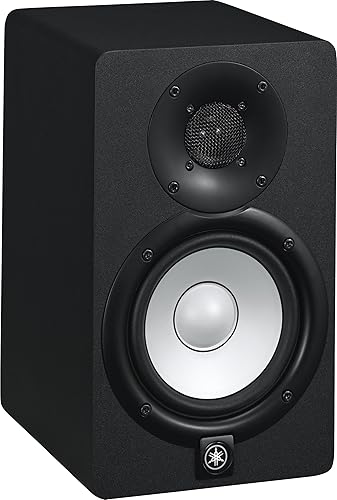
Yamaha HS5 Powered Studio Monitor, Single
The brutally honest five inch: a flat, unforgiving HS Series monitor that exposes mix problems instead of smoothing them over.
- Woofer: 5 inch cone
- Tweeter: 1 inch dome
Research-based assessment. ThePickLedger has not hands-on tested this product; this evaluation synthesizes manufacturer specifications, retailer documentation, and published expert reviews.
Questions, answered
Is the Rokit 5 G5 sold singly or as a pair?
Singly. The listing used here is for one monitor, so a stereo pair needs two purchases. Pair listings exist under different ASINs, so check the listing wording and the quantity in the basket before paying.
Do I need a subwoofer with the Rokit 5 G5?
For most music, no, but for bass-heavy genres the five inch woofer cannot represent the lowest octave with authority. A subwoofer is a later addition for low-end checking, not a day-one requirement, and headphones cover the gap in the meantime.
Are the room presets hard to set?
No. They are rear-panel switches set once for the monitor placement, such as against a wall or in a corner, and then left alone. The manual explains each setting, and the practical approach is to start flat, listen, and trim only the problem the room actually causes.