In-depth review
Yamaha HS5 Review (2026)
In-depth review of the Yamaha HS5: flat HS voicing, room controls, and whether its honesty is a strength or a punishment.
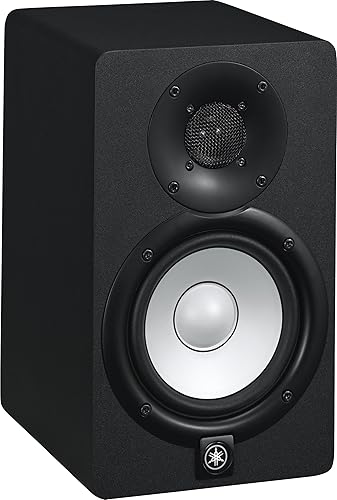
Yamaha HS5 Powered Studio Monitor, Single
The brutally honest five inch: a flat, unforgiving HS Series monitor that exposes mix problems instead of smoothing them over.
Our verdict
The Yamaha HS5 is the best studio monitor for critical mixing in this tier, because it refuses to flatter a mix. Midrange problems, level imbalances, and harsh frequencies show up clearly, which is exactly what a reference monitor should do, even when it makes early mixes sound worse than expected. Bass is limited, the voicing is clinical, and it is sold singly, but for a mixer who wants mixes that translate, the HS5 remains a benchmark.
What we like
- The HS Series voicing is deliberately flat and revealing, which makes midrange problems audible instead of hidden.
- Room Control and High Trim switches give two useful, clearly labelled corrections for wall proximity and bright rooms.
- The white cone and simple cabinet make it easy to see driver movement and to spot the monitor in a dark studio at a glance.
What to watch out for
- Bass rolls off noticeably below the mid-bass, so low end decisions need a subwoofer or a trusted headphone check.
- The honest voicing can sound thin or clinical on first listen, especially to buyers coming from consumer speakers.
- Sold singly, so a pair doubles the headline figure, and the rear port needs breathing room from the wall behind it.
Who it is for
Mixers who want a reference that punishes sloppy EQ and level choices, so mixes translate to other systems.
Honesty as a design choice
The HS Series descends from a long Yamaha tradition of reference monitoring, and the HS5 carries that philosophy in a small cabinet: flat response, clear mids, and no bass boost to hide behind. A mix that sounds balanced on the HS5 has survived a hard test, and that is why it remains a second-monitor choice in professional rooms as well as a first monitor in home studios. The trade is listening pleasure, which was never the design goal.
Living with limited bass
Bass below the mid-bass is simply not there in full, and pretending otherwise leads to mixes with too much low end added to compensate. The practical workflow is to make low-end decisions on a trusted headphone check or a subwoofer, and to use the HS5 for everything above that range, where it is ruthlessly accurate. Room Control and High Trim help with wall placement and bright rooms, but they cannot create bass the driver does not produce.
How it stacks up
Against the KRK Rokit 5 G5, the Yamaha wins on mix ruthlessness, while the KRK wins on listening comfort and bass presence. Against the JBL 305P MkII, the Yamaha wins on midrange honesty, while the JBL wins on imaging width. Against the ADAM T5V, the Yamaha wins on translation reputation, while the ADAM wins on treble detail and bass extension.
What owners report
Commonly praised
- Mix problems show up plainly, so tracks finished here tend to travel well to other speakers
- The midrange is clear and uncoloured, which suits vocal and guitar work especially well
- Build quality feels solid and studio-ready, with simple controls that do the job
Common complaints
- The sound can feel thin or clinical to listeners coming from consumer speakers
- Bass below the midrange is limited, so low-end work needs another check
- One monitor per box means the pair price is double the headline figure
Recurring themes from owner reviews on retailers and forums, summarised by our editors. Updated October 2026.
Key specifications
- Woofer
- 5 inch cone
- Tweeter
- 1 inch dome
- Total power
- 70 watts bi-amplified (45 watts LF, 25 watts HF)
- Frequency response
- 54 Hz to 30 kHz
- Inputs
- Balanced XLR and 1/4 inch TRS
Also consider

KRK Rokit 5 Generation Five Powered Studio Monitor, Single
The modern bedroom-studio standard: a fifth-generation five inch monitor with a Kevlar woofer and a reworked silk dome tweeter.
- Woofer: 5 inch woven Kevlar aramid fiber
- Tweeter: 1 inch silk dome

JBL 305P MkII Powered 5 Inch Studio Monitor, Single
The wide sweet spot pick: JBL waveguide imaging and dual Class D amps in a compact five inch cabinet.
- Woofer: 5 inch
- Tweeter: 1 inch soft dome
Research-based assessment. ThePickLedger has not hands-on tested this product; this evaluation synthesizes manufacturer specifications, retailer documentation, and published expert reviews.
Questions, answered
Why does the HS5 sound thin at first?
Because it is not adding bass or warmth that consumer speakers add. After a period of listening, the ear adjusts to the flat presentation, and the thinness reveals itself as honesty: mixes that sound thin on the HS5 usually have a genuine midrange or level problem.
Can the HS5 be used for casual listening?
It can, but it will expose poor masters and thin recordings without mercy. Many owners keep a second, more forgiving speaker for casual listening and reserve the HS5 for mixing work, which is a sensible division of labour.
Does the HS5 need a subwoofer?
For bass-heavy genres, a subwoofer or a headphone check is necessary for low-end decisions. For acoustic, vocal, and midrange-focused work, the HS5 alone is often enough, since its strength is exactly in the range those genres live in.